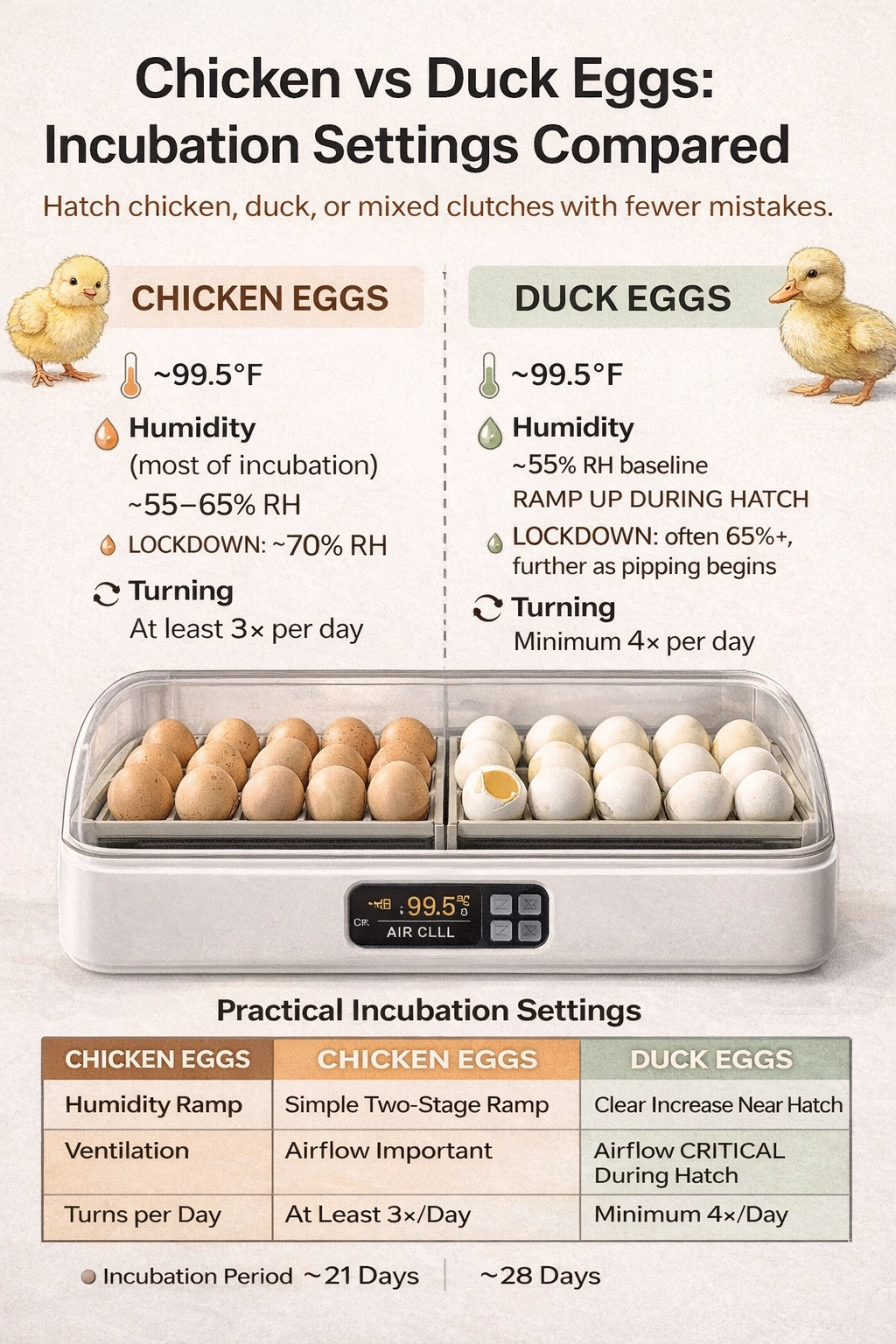
If you’ve hatched chicken eggs before, it’s totally normal to assume duck eggs work the same way. Some parts do— but a few key differences (especially late-hatch humidity and airflow) can make or break your results. This guide is written for EggBloom customers who want reliable, repeatable hatches without second-guessing every setting.
If you’re running duck eggs (or a mixed batch), a steady, consistent setup matters a lot. This is exactly why many people choose a Duck Egg Incubator that can hold stable temp, support humidity control, and keep turning consistent.
Quick Answer: Is the Incubation Temperature the Same?
For most domestic bird species, incubation temperature targets are surprisingly similar. In a forced-air (fan) incubator, the common target range is about 99–100°F (many hatchers aim around 99.5°F). In a still-air incubator (no fan), the recommended temperature is higher—often around 102°F measured at the top of the eggs.
So yes: chicken and duck eggs can share very similar temperature targets. The bigger differences usually show up in humidity strategy, ventilation timing, and how strict you need to be with turning.
Big Difference #1: Humidity (Duck Eggs Usually Need a Clear “Late Hatch” Increase)
Chicken Eggs: A Simple Two-Stage Humidity Plan
A mainstream, extension-style baseline for chicken eggs is: moderate humidity through most of incubation, then higher humidity for the final days (lockdown). The goal is steady moisture loss early (so the air cell grows) and softer membranes late (so chicks can hatch without getting “stuck”).
Duck Eggs: Similar Start, but a More Important Late-Hatch Humidity Ramp
For common domestic ducks (like Pekin-type), a widely used baseline is about 55% RH during incubation, then a bump higher in the hatch phase (often starting around day 25 when moved to a “hatcher” environment). As pipping begins, humidity is commonly increased further to keep membranes flexible and reduce late-hatch stalls.
Why higher humidity matters late (the real reason)
Once an egg pips, moisture escapes fast. If the membranes dry out, they can tighten around the duckling or chick. That’s when you see strong pips… then nothing happens for hours (or the hatch fails). Higher lockdown humidity helps keep membranes soft so the bird can rotate and “zip” out more smoothly.
Big Difference #2: Ventilation (Airflow becomes more critical late)
Embryos don’t just need warmth—they need oxygen and they produce carbon dioxide. As hatch day approaches, oxygen demand rises. Practical takeaway: good airflow matters more late in incubation, especially once pipping starts.
For ducks in particular, common hatchery-style guidance increases ventilation openings during the hatch as pipping begins. That helps keep fresh air moving without letting temperature swing.
Big Difference #3: Turning Frequency (What’s “enough,” and when to stop)
Chicken eggs
A mainstream baseline is turning chicken eggs at least 3 times per day (many guides recommend an odd number of turns), and stopping turning near the end of incubation so the chick can position itself for hatch.
Duck eggs
Duck eggs also need consistent turning. A widely cited baseline is a minimum of 4 turns per day, with many automatic systems turning hourly while eggs are in the “setter” phase. Turning is typically not needed once eggs move into the hatch phase.
Real-life tip: most turning “failures” aren’t dramatic. It’s missed turns on busy days, uneven turning, or opening the lid too often. If you want to reduce that risk, an Egg Incubator with reliable auto-turning takes a huge chunk of human error off your plate.
Can You Hatch Chicken + Duck Eggs Together?
Sometimes, yes—especially if you can keep temperature steady and manage humidity in a way that won’t sabotage either species. The tricky part is the hatch window: chickens commonly hatch earlier, while many ducks take longer. That means lockdown timing and high-humidity hatch settings can overlap in an awkward way if you set everything on the same day.
If you plan to hatch mixed clutches, many people prefer a setup that can handle consistent turning and stable conditions—like a dependable Automatic Egg Incubator where you can keep your routine simple and repeatable.
Practical “Set-and-Check” Baselines (Start Here)
These are mainstream starting points used in many poultry-science and extension-style references. Your best refinement tool is outcomes: air cell progress, hatch timing, and how cleanly birds hatch.
| Egg Type | Temperature (forced-air) | Humidity (incubation) | Humidity (lockdown/hatch) | Turning |
|---|---|---|---|---|
| Chicken | ~99–100°F | Moderate (commonly ~60–65% RH) | Higher (commonly ~70% RH) | At least 3×/day; stop near hatch |
| Duck (common breeds) | ~99.5°F (incubation); slightly lower in hatch phase is common | ~55% RH is a common baseline | Increase (often ~65%+, and higher as pipping progresses) | Minimum 4×/day; auto systems often hourly; stop in hatch phase |
Common Mistakes EggBloom Customers Tell Us They Want to Avoid
- Chasing numbers all day: stability over “perfect” readings.
- Opening the lid during hatch: humidity drops fast at the worst moment.
- Inconsistent turning: missed or uneven turns can quietly lower hatch success.
- Ignoring airflow late: pipping birds need fresh air, not stale air.
If you’re mainly hatching chickens and want a simple workflow that still supports duck eggs too, a steady chicken incubator that can handle both species can make your whole season feel easier.
Bottom Line
Chicken and duck eggs can run at very similar temperatures, especially in a forced-air incubator. The real difference is management: ducks commonly benefit from a clearer humidity ramp in the hatch phase, and both species hatch better when turning is consistent and airflow is adequate— especially late.
Data Sources
This article’s incubation baselines were verified against mainstream poultry science and extension-style references, including:
- Mississippi State University Extension (incubation temperature guidance; forced-air vs still-air)
- University of Missouri Extension (incubation humidity, turning frequency, ventilation principles)
- Cornell University College of Veterinary Medicine – Duck Research Laboratory (duck egg incubation and hatch-phase humidity/turning practices)
0 Comments