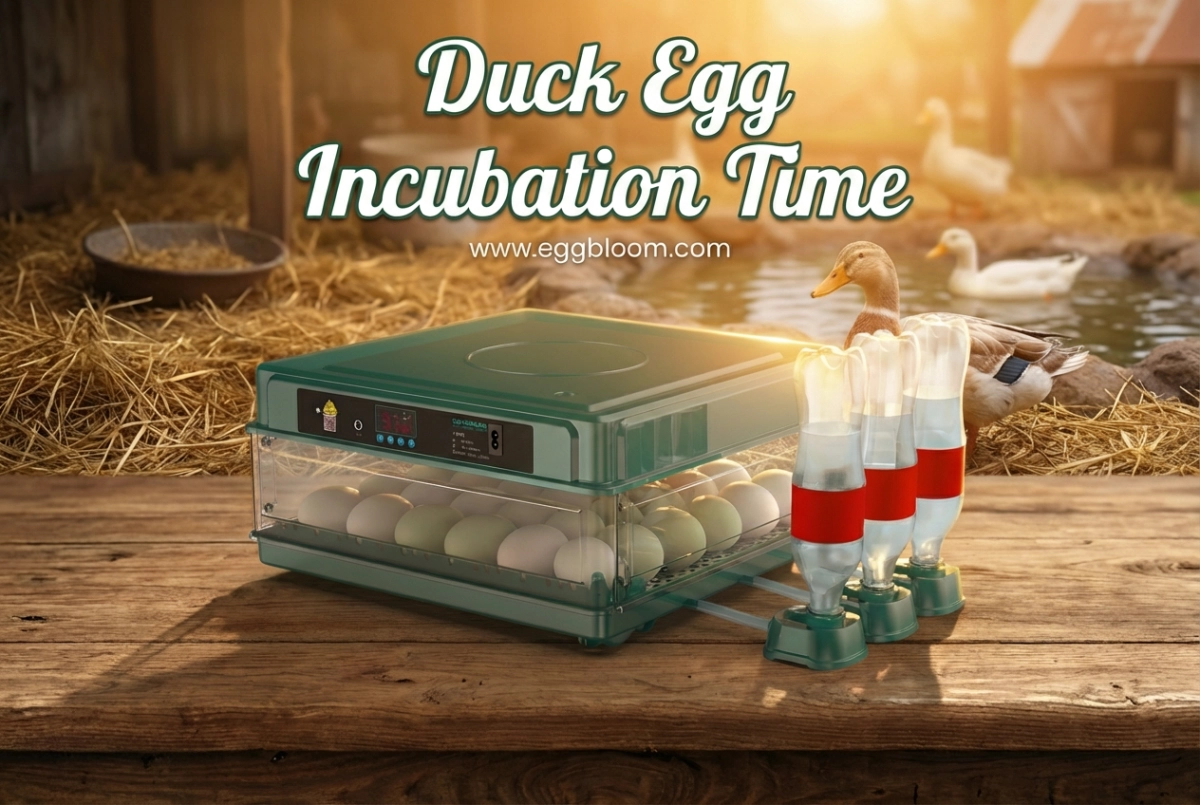
If you are staring at your incubator and counting the days, you are not alone. Most duck eggs take about this long to hatch when things go well.
| Duck Breed |
Incubation Period |
|---|---|
| Pekin |
About 28 days |
| Muscovy |
About 35 days |
Some eggs pop right on time. Others sit quiet for a day or two longer, and that is when your heart starts to sink a little. Many first-time hatchers begin to ask the same questions.
-
What temperature and humidity should I hold for duck eggs?
-
How often do I really need to turn the eggs?
-
Will opening the incubator near hatch ruin everything?
Duck egg incubation time is not a fixed promise. It is a range. When you keep simple notes on your settings and dates, you can look back and see why a hatch was early or late instead of guessing. A little patience and steady records will calm your nerves much more than watching the clock. If you are brand new to this whole process and want a full walk-through from setting eggs to hatch, our Duck Eggs and Incubator Guide for Beginners is a good place to start.
Key Takeaways
-
Most domestic duck eggs hatch in about 28 days. Muscovy eggs usually need around 35 days. Small shifts of one or two days early or late are normal if the temperature has not been perfect. If you want steadier timing for future hatches, our Duck Egg Incubator collection gives you incubators made for stable duck egg hatching at home.
-
Keep a simple hatch log. Write down the set date, breed, temperature, humidity, and turning pattern. These notes turn a “failed” hatch into a lesson instead of a mystery.
-
Candle your eggs in a dark room during the last week. A small flashlight held against the shell should show a dark body with a web of red blood vessels and a clear air cell. That tells you the embryo is still alive and close to hatching.
-
If your hatch runs a little late, do not panic. Many healthy ducklings hatch one to three days after the “due date,” especially if the incubator ran a bit cool.
-
A good incubator with steady heat, gentle air flow, and reliable humidity control keeps the timetable tighter and cuts down on late hatches. It also takes pressure off you so you can focus on watching for signs of life instead of chasing numbers.
Duck Egg Incubation Time by Breed
Each duck breed follows its own rhythm. Some push out of the shell right on day 28. Some take a slow, steady path and only hatch a few days later. When you know the usual window for your breed, you can tell the difference between “just a bit late” and “something is wrong.”
Common breeds: Pekin, Khaki Campbell, Runner, Mallard
Most backyard flocks start with Pekin, Khaki Campbell, Runner, or other mallard-type ducks. These breeds share a similar pattern. With good equipment and steady care, you will see most of these eggs hatch right around day 28. A few may pip late on day 27 or wait until day 29 before they make a move.
Use this table as a simple guide to the normal and “still okay” waiting windows for the common breeds.
| Duck Breed |
Normal Incubation Range |
Safe Extended Window |
Notes |
|---|---|---|---|
| Pekin |
27–28 days |
Up to day 30 |
Most hatch by day 28 when temperature is steady. |
| Khaki Campbell |
27–28 days |
Up to day 30 |
Very similar to Pekin in timing. |
| Runner |
27–28 days |
Up to day 30 |
May hatch a little early if your incubator runs warm. |
| Mallard-derived |
26–28 days |
Up to day 30 |
Wild-type birds sometimes hatch on the earlier end of the range. |
Tip: If you reach day 29 or 30 with these breeds and still do not see a pip, candle the eggs in a dark room. If you see movement and good blood vessels, they likely just need a little more time.
Muscovy, Magpie, Bantam, and rare breeds
Some breeds do not follow the “28-day” rule at all. Muscovy ducks are the classic example. Their eggs take about a week longer than the common mallard-type ducks. Magpie and many bantam ducks often follow the same basic pattern as Pekins, but egg size and shell thickness can nudge the timing a little.
Less common and rare breeds may sit anywhere between the mallard-type and Muscovy range. When you work with a rare breed, it is always wise to ask a breeder or check a breed guide so you know what to expect before you set the eggs.
Here is a simple guide for these breeds.
| Duck Breed |
Normal Incubation Range |
Safe Extended Window |
Special Notes |
|---|---|---|---|
| Muscovy |
34–35 days |
Up to day 38 |
Slow-growing embryos and thicker shells; needs good humidity at hatch. |
| Magpie |
27–28 days |
Up to day 30 |
Very close to Pekin timing; watch egg size and weight loss. |
| Bantam |
27–28 days |
Up to day 30 |
Smaller eggs can lose moisture faster; watch humidity closely. |
| Rare Breeds |
Varies (about 28–35 days) |
+2–3 days |
Check breeder or breed guide for the best range before you set eggs. |
You will often see Muscovy eggs sit quietly past the 35-day mark and then start pipping on day 36 or 37. That does not always mean you did anything wrong. It is just how this breed grows. Magpie duck incubation time usually matches the common breeds. Bantam ducks may feel like they should hatch early because they are small, but in practice they often follow the same schedule as the larger birds.
Note: Call duck eggs often hatch on the early side, around day 26–27, but it is still reasonable to wait until day 29 if candling shows good movement and strong veins.
Safe waiting windows for each breed
Most of the worry you feel in the last few days comes from not knowing how long you can safely wait. A “safe window” is the extra time beyond the normal hatch day where late but healthy ducklings often still hatch.
Use this table as a quick reference when you are tempted to give up too soon.
| Breed |
Normal Incubation Days |
Safe Waiting Window |
When to Consider Assistance |
|---|---|---|---|
| Mallard-derived |
26–28 |
Up to day 30 |
Only after an external pip has sat for about 36–48 hours with no progress. |
| Muscovy |
About 35 |
Up to day 38 |
After 36–48 hours post external pip with no change and no active veins. |
| Magpie |
27–28 |
Up to day 30 |
Same as other mallard-type ducks; wait if veins are still clear. |
| Bantam |
27–28 |
Up to day 30 |
Late but viable eggs still show movement and a good air cell. |
| Call Duck |
26–27 |
Up to day 29 |
Consider help only if pipped for 36–48 hours with no change. |
Always pair this table with your own notes. Write down when you set the eggs, what temperatures you held, and how the humidity behaved. That way, when you hit a late hatch, you can say “this incubator ran a little cool, so I can safely wait another day” instead of guessing.
�� Keep a Hatch Log: A plain notebook with dates, breeds, temperature, humidity, and candling notes is one of the best tools you can own. Each hatch will teach you something that makes the next one smoother.
Some breeds, like Muscovy, almost always ask for more patience. Others follow the book more closely. When you understand the natural range for your breed, you can stop blaming yourself for every slow egg and start making calmer, better decisions. If you would like a day-by-day look at how Muscovy eggs change over the full cycle, our Muscovy incubation day-by-day chart walks through the whole 35-day stretch in order.
If you are using a broody duck on a nest and want to follow the natural pattern, you can match what you see in the nest with our Duck Hatching Time Day-by-Day Guide for Natural Incubation.
How Long Does It Take for Duck Eggs to Hatch? Key Factors
Temperature and humidity effects
Once you start a hatch, temperature and humidity are the two dials that matter most for timing. A steady setting around 37.5°C (99.5°F) in a forced-air incubator keeps embryos growing at a normal pace. Cooler than that slows them down and pushes hatch day back. Hotter than that speeds them up, but it also raises the risk of weak or deformed ducklings.
| Temperature (°C) |
Effect on Hatching Time |
Duckling Traits |
|---|---|---|
| About 37.0 |
Hatch may run a little late |
Embryos grow, but more slowly; some late hatches |
| About 37.5 |
Hatch time stays near the normal range |
Good growth and strong ducklings when humidity is also right |
For humidity, many home hatchers aim for about 45–55% during most of incubation. Then they raise it for the last few days to help soften the shell and keep membranes from drying out while the duckling pips and zips. What matters most is that humidity is steady and matches how quickly your eggs are losing weight, not that the number is perfect every minute.
Incubating duck eggs: incubator vs. broody duck
You can let a broody duck do the work, or you can use a machine. Both ways can work well. A broody duck knows how to turn eggs, shift her body, and protect the nest. But she is also at the mercy of weather, predators, and her own habits.
An incubator lets you control temperature and humidity much more closely. That usually means tighter hatch windows and fewer surprises. When the incubator holds a steady 37.5°C (99.5°F) with gentle air flow and the humidity stays in range, you will often see more eggs hatch right on time and fewer very early or very late ducklings. If you want more help comparing incubator styles before you buy, our Best Duck Egg Incubators for Home, Classroom, and Small Farms guide walks through the main options.
-
Incubators give you steady conditions and a clearer timetable.
-
Broody ducks can do a beautiful job, but their timing can drift with weather and how often they leave the nest.
Egg quality, storage, and turning
The story of your hatch starts before the eggs ever touch the incubator. Fresh, clean eggs that are less than a week old usually give the best results. As storage time goes up, hatch rates and timing both tend to suffer.
Store hatching eggs in a cool room, not the fridge, and tilt or turn them a couple of times a day so the yolk does not stick to one side. Once they are in the incubator, gentle and frequent turning keeps the embryo centered and helps blood vessels grow in a healthy pattern.
| Factor |
Impact on Hatchability |
|---|---|
| Storage Duration |
Eggs set within about 7 days of laying hatch best; longer storage usually lowers the hatch rate. |
| Turning Frequency |
Turning several times a day during incubation helps more embryos develop normally and hatch on time. |
| Egg Quality |
Cracked, misshapen, or dirty eggs are more likely to fail and can throw off your sense of normal timing. |
�� Write down your storage time, temperature, humidity, and turning habits for each batch. When something runs late, those notes will tell you whether the eggs were older, the temperature ran low, or the humidity drifted.
Duck Egg Hatching Delays: Checklist and Decision Guide
Candling late eggs: what to look for
When you are past the “due date,” candling is your best friend. Take one egg at a time into a dark room. Hold a bright light snug against the large end of the shell. Move the egg slowly and watch what is happening inside.
Use this table as a simple guide to what you see.
| Indicator Type |
Healthy Eggs |
Non-Viable Eggs |
|---|---|---|
| Embryo Appearance |
Dark body filling most of the egg with a clear air cell at the big end |
Small dark area that does not grow, or a dark ring around the middle of the egg |
| Movement |
Soft, gentle movement when you tilt the egg or hold it still under the light |
No movement after several careful checks |
| Blood Vessels |
Clear, sharp red lines like a fine spider web |
Broken lines, cloudy streaks, or no vessels at all |
| Shell Condition |
Shell is clean, uncracked, and dry |
Cracks, leaks, or stained areas that suggest infection |
| Infertility |
Not applicable |
Clear egg with no veins or embryo growth at all |
| Early Deaths |
Not applicable |
Dark ring around the yolk (“blood ring”) with no live vessels |
| Late Deaths |
Looks like a full, live embryo with active veins |
Embryo present but blood vessels have faded or broken down |
In the final week, a healthy egg looks mostly dark with a large air cell that tips down along one side. You may see a beak or foot move when you watch quietly for a few seconds. Eggs that stay clear, show a blood ring, or never move after repeated checks should be removed so they do not leak or burst.
Tip: By the last few days, the air cell should look like a large slanted bubble at the big end of the egg. If it is very small, humidity has likely been too high. If it is very large and the egg feels light, humidity has likely been too low.
When to wait, assist, or stop
Late eggs test everyone’s patience. The trick is to let live ducklings finish on their own while not holding on to eggs that are no longer viable. Use this simple checklist as you work through a late hatch.
Basic late-hatch checklist:
-
Candle each egg and check for movement.
-
Look for clear, bright blood vessels around the air cell.
-
Check the size and slope of the air cell.
-
Remove any eggs that are clear, show a strong blood ring, or smell bad.
-
Raise humidity a little if the air cell looks too small and shells seem hard and dry.
-
Watch pipped eggs for progress over time instead of poking or peeling too soon.
Use this table to match what you see with what to do next.
| Situation |
Action |
|---|---|
| Live movement and clear blood vessels when candling |
Return the egg to the incubator. Keep temperature steady and humidity in range. Wait and recheck later. |
| Membrane looks dry and white around a pipped area |
Raise humidity. You may lightly moisten the membrane with warm, sterile water or saline at the very edge, then wait again. |
| Duckling has pipped but yolk sac is not absorbed |
Do not pull the duckling out. Close the incubator and give it more time to finish absorbing the yolk. |
| External pip for 36–48 hours with no progress, no active blood vessels, and duckling still alive |
Carefully begin to widen the pip line a little at a time, watching for bleeding. Stop if you see fresh blood and return the egg to the incubator. |
| No movement, no veins, or signs of rot |
It is time to stop. Remove the egg and do not open it in your home or near other eggs. |
As a rule, if you still see veins and movement, time is your friend. If the shell is pipped and nothing changes for more than a day and a half, and the veins have faded, careful help may save a duckling. But rushing to assist too soon can do more harm than good.
Note: Ducklings need time to absorb their yolk sac and let blood vessels shut down before they leave the egg. Helping before that is finished can cause bleeding and weak, struggling ducklings.
If you want more predictable hatches in the future, focus on giving your eggs a calm, steady environment. A stable incubator and a simple log book will do more for your nerves than any trick. When you are ready to upgrade, look for an incubator that holds temperature and humidity tight for duck eggs rather than one that just “works well enough.” Our own Chicken & Duck Egg Incubator with Auto Turn Dual Motor is built to keep duck and chicken eggs on a steady schedule with even air flow and automatic turning.
Emotional support for anxious hatchers
Waiting is the hardest part, especially on your first hatch. When the due date passes and the incubator is still quiet, it is easy to think you have done everything wrong. I have walked many new hatchers through this same stretch, and I can tell you this: a late hatch does not automatically mean a failed hatch.
Here are a few simple ways to stay grounded while you wait.
-
Keep your hands busy with your hatch log instead of the eggs. Write down what you see when you candle and how long each egg has been pipped.
-
Trust what the egg shows you. Movement and clear veins are worth more than the calendar date.
-
Remember that many healthy ducklings hatch a day or two late, especially if the incubator ran cool.
-
Reach out for help if you feel stuck. Reading a day-by-day guide or talking with other duck keepers can calm your mind and give you a plan.
-
Celebrate small wins along the way, like a strong heartbeat on candling or the first quiet peep from inside the egg.
�� Barnside Mentor’s Advice: “I once had a new hatcher call me on day 32 with Muscovy eggs. He was sure they were all gone. We candled together, saw good veins, and decided to wait. By day 36 he had a brooder full of noisy ducklings and a very big smile.”
Every batch of eggs teaches you something. Even the rough hatches make the next round better if you take notes and adjust. Stable equipment, steady habits, and a calm head will carry you a long way.
When you feel ready to make the work easier on yourself, take a look at our duck egg incubator range and see which setup fits your home flock and your goals.
Tools and Tips for Successful Incubating Duck Eggs
Best incubators and monitoring tools
The right incubator will not do the work for you, but it will make your job much easier. For duck eggs, you want steady heat, even air flow, and humidity that does not swing wildly every time the room changes.
Many backyard keepers like small automatic models with digital displays. These units hold a set temperature, turn the eggs for you, and let you fine-tune humidity. When those parts stay stable, hatch timing becomes more predictable and late hatches are less common.
| Incubator |
Features |
User Review |
|---|---|---|
| Automatic household incubator |
Simple controls and gentle, even heating for small batches |
"Great for my first duck eggs. Easy to understand." |
| 20-egg incubator |
Enough space for a small flock with stable temperature and humidity |
"Reliable timing and solid hatch rates for mixed duck breeds." |
| Dual-duct automatic incubator |
Balanced warm air circulation to keep all egg levels even |
"Helps keep every corner of the tray at the same temperature." |
| Portable mini incubator |
Compact and easy to move; good for classroom or small home projects |
"Perfect for a classroom duck project with my students." |
| Full automatic incubator |
Precise control of temperature, humidity, and turning for serious hobbyists |
"Once dialed in, it holds the settings and keeps hatches on schedule." |
Whatever model you choose, make sure you can read the temperature at egg level, check humidity, and see how air moves through the box. A good incubator is not just about features on the box; it is about how stable it runs day after day.
| Feature |
Details |
|---|---|
| Temperature |
Hold around 99.5°F (37.5°C) in a forced-air incubator for most of the hatch. |
| Humidity |
Aim for about 45–55% during most of incubation, then raise to about 65–75% for the last few days to help hatching. |
| Turning Frequency |
Turn at least 3–5 times daily until lockdown, or use an automatic turner to keep movement gentle and regular. |
| Ventilation |
Allow fresh air in and stale air out without letting drafts blow directly on the eggs. |
| Avoid Opening |
Keep the lid closed as much as you can, especially during hatch, so heat and humidity stay stable. |
Tip: Test any new incubator for at least 24–48 hours with no eggs inside. Use two thermometers and at least one hygrometer at egg level. Make sure it can hold a steady 37.5°C (99.5°F) before you trust it with your best duck eggs.
Record-keeping and troubleshooting
Good records turn a frustrating hatch into a useful lesson. When something runs late, you will not have to guess why. You can look back at your notes and see what happened.
Here are a few simple things to write down for every batch.
| Practice |
Description |
|---|---|
| Document set date |
Write down the day and time you set the eggs and which breeds are in the tray. |
| Temperature/Humidity targets |
Note your chosen settings for each stage and any changes you make along the way. |
| Turning schedule |
Keep track of how often eggs are turned or when you turn off the automatic turner for lockdown. |
| Candling results |
Record what you see at each candling, especially near the end when you are watching late eggs. |
| Ventilation settings |
Note how open vents are and when you adjust them as chicks hatch and need more air. |
| Adjustments |
Write down any power cuts, big temperature swings, or other events that might explain late hatches. |
-
A small notebook beside the incubator can save you hours of guessing after the hatch.
-
Those notes also help you see which settings work best for your room, your incubator, and your ducks.
�� After each hatch, sit down for five minutes and jot down what worked and what you want to change next time. Over a few batches, you will watch your hatch rate climb and your stress drop. If you want a full, step-by-step walk-through for future hatches, our How to Hatch Duck Eggs: Complete Guide for Beginners and Hobbyists pulls everything together in one place.
You can expect duck eggs to hatch at different times depending on the breed, the equipment, and how steady your settings are. Use this short summary as a quick reminder when you are planning your next hatch.
| Key Point |
Description |
|---|---|
| Incubation Time |
Most duck eggs hatch in about 28 days, while Muscovy eggs need around 35 days. |
| Detection Methods |
Candling in a dark room shows you movement, blood vessels, and air cell size so you can judge if late eggs are still alive. |
| Breed Differences |
Different breeds follow different timelines, so always check the normal range for the ducks you are hatching. |
Delays are part of hatching, not a sign of failure by themselves. The key is to read what the eggs are telling you, keep your environment steady, and give ducklings the time they need to finish the job. When you do that, you will find that late hatches are less scary and more often end with healthy, noisy ducklings.
FAQ
How do you know if a duck egg is still alive late in incubation?
Take the egg into a dark room and candle it with a bright flashlight held against the large end. A live, late-stage egg will look mostly dark, with a clear air cell and a tangle of red blood vessels. You should see gentle movement when you hold the egg still for a few seconds. If you see no vessels, no movement, or a dark ring around the egg, that egg is most likely no longer viable.
What should you do if duck eggs are late to hatch?
First, keep the incubator running at a steady 37.5°C (99.5°F) with good humidity. Then candle the eggs. If you still see movement and strong veins, keep waiting, even if the calendar says you are a day or two late. If you reach the end of the safe window for your breed with no movement or veins, it is time to stop.
Can you help a duckling hatch if it is stuck?
You can sometimes help, but only when you are sure it is time. Wait until a duckling has had an external pip for at least 36 hours with no progress, and check that there are no active blood vessels in the area you plan to open. Then you can gently widen the pip line a little at a time. Stop and return the egg to the incubator if you see blood. Helping too early is far more risky than waiting a little longer.
Why do Muscovy duck eggs take longer to hatch?
Muscovy duck embryos simply grow more slowly than mallard-type ducks. Their shells are thicker and their full development takes longer, so a 35-day hatch is normal. Many Muscovy hatches run to day 36 or 37 and still produce healthy ducklings. As long as candling shows movement and clear veins, extra days for Muscovy eggs are usually no cause for alarm.
How can you improve your hatch rates next time?
Focus on the basics. Use a stable incubator, test it before you set eggs, and keep good notes on temperature, humidity, and turning. Choose fresh, clean eggs, and match your settings to your climate and room. After each hatch, look back at your notes and any late hatches or losses. Adjust one thing at a time for the next batch, and pair this article with our Duck Eggs and Incubator Guide for Beginners from Egg to Hatch so you have both the timeline and the full process side by side.
0 Comments