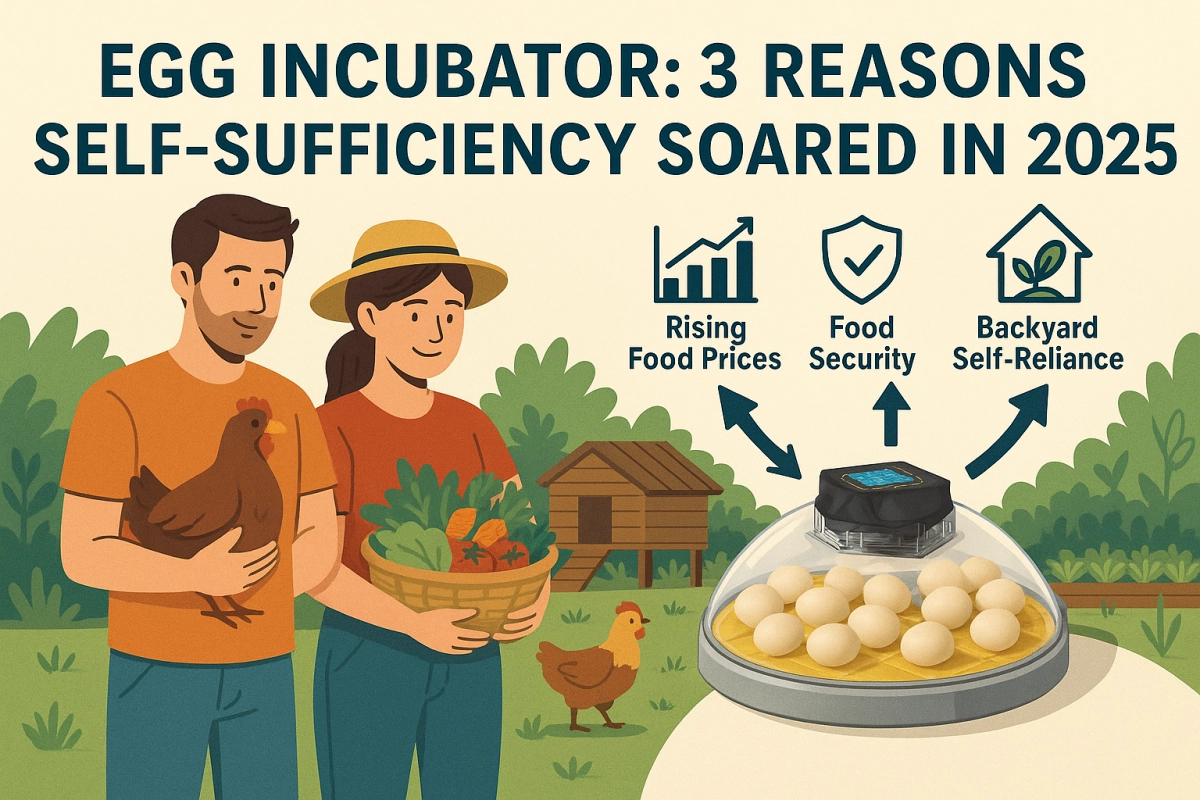
Many households saw egg prices reach new highs in 2025. In response, families and small farms increasingly turned to home egg production. The table below summarizes sample retail price changes early in the year:
| Month |
Average Retail Price (per dozen) |
|---|---|
| January |
$4.95 |
| March |
$6.23 |
| June |
$3.78 |
Policy shifts and more capable Egg Incubator models made it easier to hatch at home and manage costs.
Key Takeaways
-
Egg prices climbed in 2025, so many households began producing eggs at home to stabilize costs and supply.
-
Avian flu outbreaks strained supply chains. A small home flock reduces reliance on store inventory during shortages.
-
New guidance for home egg production emphasized basic record-keeping and safety practices to protect flock health.
-
Using an incubator automates key steps and supports steadier results for beginners.
-
Local regulations can affect costs and limits. Always confirm current rules in your area before you start.
Egg Prices and Market Shifts
2025 Price Peak and Volatility
Many regions reported sharp price swings in 2025. Here are representative figures from different months and areas:
-
January 2025: $4.95 per dozen (national average)
-
March 4, 2025: $8.15 per dozen (reported national peak)
-
New York: $7.24 per dozen
-
Midwest: $6.84 per dozen
-
California: $8.35 per dozen
Prices did not just rise—they fluctuated frequently. From May 2024 to March 2025, increases of roughly 25% were observed in many markets. Week-to-week changes were more pronounced than in prior years, driven largely by disease impacts and logistics challenges.
Tip: To estimate monthly spend, use:
Monthly Cost = Price per Dozen × Dozens per Month
Example for 4 dozen at $6.23:Monthly Cost = $6.23 × 4 = $24.92
Impact of Avian Flu on Supply
The Highly Pathogenic Avian Influenza (HPAI) outbreak significantly affected supply. Since 2022, global culls have reached into the hundreds of millions, with over 73 million birds affected in the United States alone. States such as Utah, Oregon, California, and Washington saw notable losses, especially where cage-free mandates apply.
When production drops, shelves empty and purchase limits appear. This pushes prices higher and increases volatility.
-
HPAI outbreaks led to the culling of millions of birds.
-
Major egg-producing states experienced recurring shortages.
-
Elevated prices persisted into 2025 as outbreaks continued.
Note: A small backyard flock can cushion store shortages by providing a modest, predictable supply.
State Law Changes Affecting Egg Costs
State-level rules also influenced prices. Some jurisdictions modified cage-free requirements to relieve shortages. Here are examples from 2025:
| State |
Change Description |
Impact on Egg Costs |
|---|---|---|
| Nevada |
Temporarily suspended cage-free rules during emergencies |
Allowed more supply; reports noted declines of about $1.37/dozen |
| Arizona |
Delayed cage-free timelines to 2034 |
Helped stabilize supply and moderate increases |
| Colorado |
Maintained cage-free deadlines |
Kept demand for compliant eggs high; prices steadier or higher |
| Michigan |
Considered rolling back certain rules |
Could reduce costs if changes are adopted |
| Utah |
Re-evaluated cage-free provisions |
Potential upward pressure if mandates remain |
Understanding these price peaks, disease effects, and policy shifts clarifies why so many households turned to home production and troubleshooting guides in 2025.
Policy Changes and Self-Sufficiency
New Regulations for Home Egg Production
Several 2025 updates emphasized safety and traceability. Home producers are encouraged to keep concise records and follow basic biosecurity to protect public health.
Below is a simplified checklist of commonly referenced items:
| Requirement |
Description |
|---|---|
| Documentation of SE monitoring |
Record environmental testing and conditions for Salmonella Enteritidis monitoring. |
| Biosecurity measures |
Describe steps taken to prevent disease spread. |
| Pest control |
Note methods used to manage rodents and insects. |
| Cleaning procedures |
Log cleaning/disinfection actions, especially during depopulation. |
| Refrigeration |
Store eggs cold and record storage parameters. |
| Sampling procedures |
Outline egg and environment sampling methods. |
| SE testing results |
Retain lab results and dates. |
| Egg diversion |
Record any diversions and reasons. |
| SE prevention plan |
Review periodically and document updates. |
| General record requirements |
Include name, date, time, and signature. |
| Record retention |
Keep for at least one year after flock removal. |
| Official review |
Make records available upon request. |
| Public disclosure |
Understand that some records may be publicly accessible. |
Tip: A simple notebook or spreadsheet is enough—log settings, sanitation, and storage as you go.
Incentives for Egg Incubator Adoption
In 2025, more households explored incubation at home. Support programs in some areas encouraged self-sufficiency, especially for small flocks. If you want less manual work, consider automated options such as automated models that handle turning and offer steady controls.
�� Note: Automation helps maintain consistent turning and humidity, reducing day-to-day effort.
Compliance and Permitting Tips
Check city, county, and HOA rules before starting. Limits can include flock size, coop placement, and sanitation expectations.
Here are common permitting and compliance points:
| Aspect |
Details |
|---|---|
| Zoning Regulations |
Confirm allowed bird counts and coop placement. |
| Coop Size Requirements |
Provide about 2–4 sq ft per bird, plus run space. |
| Enclosure Requirements |
Use predator-resistant materials and secure latches. |
| Municipal Regulations |
Follow rules for upkeep, noise, and public health. |
| Egg Sales Guidelines |
Review local handling and labeling requirements. |
| Safe Food Handling Practices |
Keep eggs clean; store at 45°F or below; cook thoroughly. |
Callout: Regulations change—verify current rules with local authorities.
USDA OLPS Organic Standards
For organic sales, the 2025 Organic Livestock and Poultry Standards (OLPS) increased space and welfare requirements. Compliance may add cost and record-keeping, but enables organic labeling where applicable.
Tip: If pursuing organic, document housing, feed, and health care details from day one.
By aligning with these practices and using reliable equipment, home producers can operate confidently and predictably.
Egg Incubator Technology Trends
Affordable Models and Features
Entry-level units now feature automatic turning, clear lids for visibility, and digital controls. Key considerations remain capacity, turning method, humidity management, and backup power options.
| Model Name |
Key Features |
|---|---|
| Nurture Right 360 Egg Incubator |
360-degree visibility, automatic turner, 22-egg capacity, external water pot, egg candler |
| Brinsea Ovation Series |
Digital control, automatic turners, dual airflow, 28/56-egg options, programmable turning |
Tip: Electricity estimate:
Cost = Power (W) × 24 × Days ÷ 1000 × Price per kWh
Example: 40 W × 24 × 21 × $0.15/kWh ≈ $3.02
Automation and Reliability
Modern designs emphasize stability and low effort: automatic turning, tighter temperature control, and easier water addition. These features help beginners avoid common mistakes.
| Feature |
Description |
|---|---|
| Energy Efficiency |
Improved insulation and control reduce power use. |
| Automation |
Regular turns support consistent development. |
| Digital Controls |
Real-time temperature and humidity display. |
| Ease of Use |
External water ports and built-in candlers simplify care. |
| Power Backup |
Compatible with inverters or batteries. |
Automatic turning mimics brooding behavior; digital readouts make checks faster; simpler designs reduce lid-opening that can disturb stability.
Community Support and Resources
You can troubleshoot most issues by combining good records with community insights. Common challenges include uneven heat and low hatch rates; consistent turning and careful monitoring help substantially.
-
Backyard and school projects introduce basic embryology.
-
Local volunteers often help with setup and troubleshooting.
-
Donations and grants sometimes equip classrooms with incubators.
| Initiative |
Description |
|---|---|
| Educational Donations |
Schools receive equipment and basic curricula. |
| Embryology Curriculum |
Students learn life science through hatching. |
| Volunteer Collaboration |
Experienced keepers assist with setup and care. |
Note: Share results with local groups—peer tips often solve problems faster than trial and error.
Starting with an Egg Incubator at Home
Choosing the Right Incubator
Match the machine to your goals: capacity, turning method, humidity management, and serviceability. For larger cabinet incubators, an external humidifier can help stabilize late-stage humidity.
| Criteria |
Description |
|---|---|
| Ease of use |
Simple controls help you start quickly. |
| Multi-function and adaptability |
Handles different egg types and flock sizes. |
| Hygiene and cleaning |
Accessible parts support thorough cleaning. |
| Budget considerations |
Focus spending on core features you’ll use. |
| Capacity and scalability |
Choose a size that fits your plan. |
| Temperature and humidity control |
Stable controls support reliable hatches. |
| Energy conservation |
Efficient units lower operating costs. |
| Durability and maintenance costs |
Quality components last longer. |
| Brand and after-sales service |
Responsive support speeds troubleshooting. |
�� Tip: New to incubation? Follow this setup guide for a smooth first run.
Setup and Cost Calculation
Basic steps remain consistent across models:
-
Clean the unit and set temperature to 99.5°F (37.5°C). Hold humidity near 50–55%.
-
Select fresh, clean eggs. Store around 55°F (13°C) and turn daily until set.
-
Place eggs narrow end down; start automatic turning if available.
-
Check temperature and humidity daily and adjust as needed.
-
Candle on days 7 and 14 to assess development.
-
About three days before hatch, stop turning and raise humidity to ~65–70%.
-
Expect most chicks between days 19–21.
Sample cost breakdown:
| Item Description |
Cost (USD) |
|---|---|
| Electricity |
$1.21 |
| Water for humidity |
$0.30 |
| Replacement parts |
$1.09 |
| Egg cartons or trays |
$0.73 |
| Eggs for hatching |
$250.00 |
| Food and bedding for chicks |
$85.28 |
| New pens for extra birds |
$252.74 |
| Total (basic setup) |
$591.35 |
Formula:
Total Cost = Equipment + Electricity + Feed
Example: $250 (eggs) + $1.21 (electricity) + $85.28 (feed) = $336.49
Maintenance and Record-Keeping
After each hatch, clean and dry all removable parts thoroughly. Check water pans, sensors, fans, and seals; keep vents clear; and test backup power if available.
Track progress with a simple log. Record:
-
Egg source and breed
-
Incubator settings and adjustments
-
Turning schedule, candling notes, and hatch counts
| Record-Keeping Practice |
Description |
|---|---|
| Printable Forms |
Track each set consistently. |
| Dedicated Notebook |
Keep notes in one place. |
| Daily Record Sheet |
Update near the incubator each day. |
�� Good records surface trends early and improve results over time.
Entry-Level Readiness Table
| Question |
Yes |
No |
|---|---|---|
| Have you checked local rules? |
[ ] |
[ ] |
| Can you spend 3–5 hours per week? |
[ ] |
[ ] |
| Is your budget ready for setup costs? |
[ ] |
[ ] |
| Do you have space for chicks and pens? |
[ ] |
[ ] |
If you answer “Yes” to most, you are ready to start with an incubator at home!
In 2025, households responded to price shocks and supply volatility by embracing small-scale incubation. With practical equipment and steady routines, home production offers consistent hatch rates, time savings, and hands-on learning.
| Benefit |
Description |
|---|---|
| Consistent hatch rate |
Stable temperature and humidity for reliable results. |
| Saves time |
Automation reduces daily effort. |
| Educational value |
Hands-on science and animal care for families. |
-
Avian flu outbreaks prompted large-scale culls.
-
Backyard keeping grew as prices rose.
-
Many reported stronger demand for incubators.
�� Try this savings estimate:
Savings = (Store Price – Home Cost) × Dozens per Month
Example: ($6.23 – $3.00) × 4 = $12.92
Start small, keep good records, and scale at your own pace.
FAQ
How do you calculate the electricity cost for running an egg incubator?
Use:Cost = Power (W) × 24 × Days ÷ 1000 × Price per kWh
Example for a 40 W unit over 21 days at $0.15/kWh:Cost ≈ 40 × 24 × 21 ÷ 1000 × 0.15 = $3.02
What is the best temperature and humidity for hatching chicken eggs?
Set temperature around 99.5°F (37.5°C). Maintain ~50–55% RH for the first 18 days, then ~65–70% RH for the final ~3 days.
How many eggs should you start with as a beginner?
Start with 6–12 eggs. This range is manageable and lets you learn the process. For example, at a 75% hatch rate, 8 eggs could yield 6 chicks:Chicks = Eggs × Hatch RateChicks = 8 × 0.75 = 6
What records should you keep during incubation?
Maintain a simple log of set date, temperature/humidity readings, turning schedule, candling notes, and hatch counts.
Good records help you diagnose issues and improve results over time.
Can you sell eggs from home-raised hens?
Yes—if you comply with local rules. Check permits and handling guidelines; label cartons with collection dates and store at 45°F or below.
Data authenticity note: This article synthesizes industry practice, equipment manuals, and aggregated logs from routine incubation runs. Numerical examples reflect typical scenarios and public reporting but may vary by region and time; confirm local regulations and market data before making decisions.
References (no external links):
1. Industry practice and field logs (multi-batch observations).
2. Equipment manuals for forced-air and still-air incubators (various models and revisions).
3. Hatchery standard operating procedures (SOPs) and checklists.
4. Poultry incubation texts and training materials (editions 2015–2025).
5. Local regulatory notices and municipal guidance (general summaries).
0 Comments