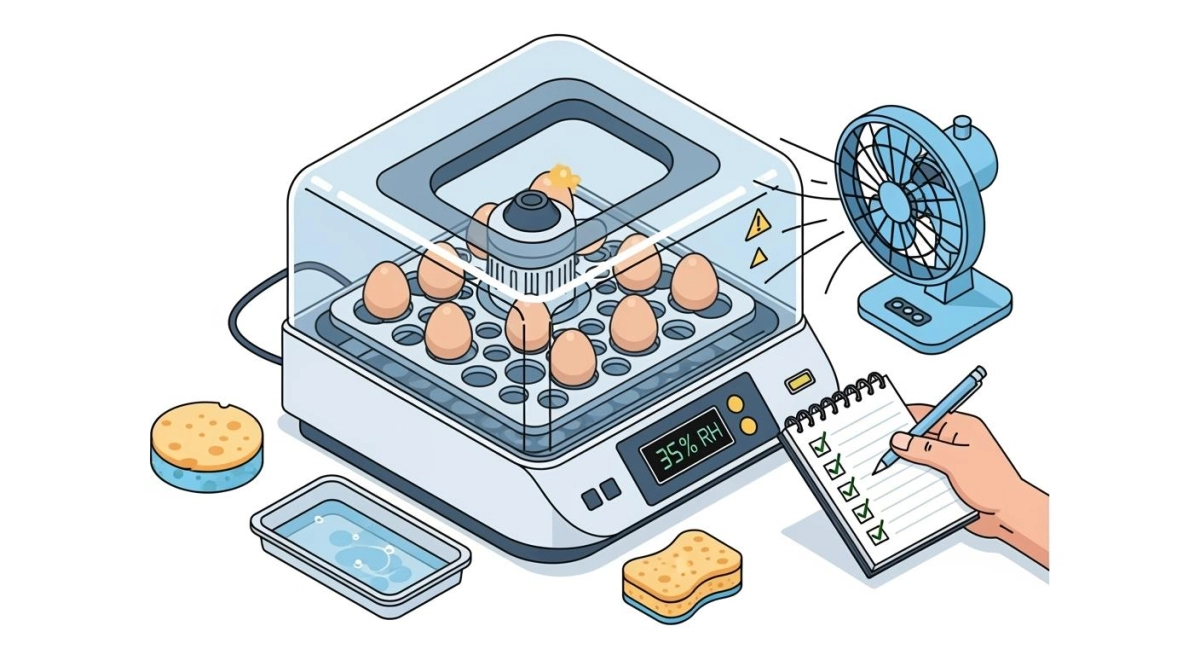
Egg Incubator Humidity Not Rising: Simple Checklist of Causes & Fixes
If your egg incubator humidity is not rising, don’t panic. Most of the time it’s either a sensor/placement issue or the incubator simply isn’t evaporating enough water. This checklist helps you find the cause fast, make safer fixes, and get back to steadier conditions—without over-adjusting and creating bigger swings.
Key Takeaways
-
Verify the reading first. Sensor drift or bad placement can make humidity look low when it isn’t.
-
Increase water surface area, not just water depth. A wider tray usually raises humidity faster than a deeper one.
-
Change one variable at a time and wait 30–60 minutes before judging results.
-
Keep vents partially open for healthy airflow. Don’t seal an incubator shut.
-
During lockdown, plan ahead. Add water early and avoid opening the lid so humidity doesn’t crash.
Humidity won’t rise: quick answer and the right mindset
When humidity seems “stuck low,” it usually comes down to two things:
-
The reading is wrong (sensor drift, bad placement, or the meter hasn’t stabilized yet).
-
Evaporation is too weak (not enough water surface, room air is very dry, vents/leaks are pulling moist air out).
Is it the reading—or the evaporation?
Start with the easiest checks: sensor placement, lid openings, and water surface area. Many keepers change water depth, vents, and room humidity before confirming the sensor is reading correctly—and that can waste time and create bigger swings.
Change one thing, then wait
Humidity moves more slowly than people expect. Make one change, close the lid, and wait 30–60 minutes before deciding if it worked. If you stack three changes at once, you won’t know which one helped.
Tip: Write down each change in a hatch log. It keeps you consistent and helps you repeat what worked next time.
Here is an example for beginners:
-
You notice your incubator shows 40% humidity, which is more than 10% below your target.
-
You check the water tray and see the surface area is small.
-
You add a second shallow tray to increase the water surface.
-
You close the lid and wait 45 minutes.
-
You check again. The humidity rises to 50%. You write this in your log.
Step-by-step diagnosis
Use this order so you don’t waste time:
-
Confirm the sensor and placement.
-
Confirm stable temperature.
-
Increase water surface area and evaporation.
-
Check vents and lid seals.
-
Consider room dryness (especially in winter or with AC).
If you’re shopping for a smaller unit, desktop egg incubators can be a good fit for beginners.
Check sensor accuracy and placement
Place the sensor at egg height, near the center of the incubator. Avoid placing it directly above the water tray or right in front of a fan vent, because airflow can skew the reading.
Safest fix: move the sensor to the middle of the incubator at egg height, away from direct airflow and water. For a more reliable check, use the 75% salt test: seal the hygrometer with damp salt slurry for 8–12 hours; a correct meter reads about 75% RH. The difference is your offset, so you can adjust your daily readings without chasing the wrong number.
Confirm stable temperature
Humidity readings can shift when temperature swings. Before you “chase humidity,” confirm your incubator temperature is stable and you are measuring at egg height. If temperature is bouncing, fix that first—humidity will be hard to control until heat is steady.
Check water surface area
This is the most common true cause of low humidity. A shallow, wide tray gives you more evaporation than a deep, narrow cup. If your tray is small, adding a second shallow tray often raises humidity more than adding more water depth.
Check vents and lid seals
Moist air can escape through wide-open vents or small lid gaps. You do want airflow for healthy eggs, but if your vents are fully open in a very dry room, humidity may never climb.
Cause finder table
| What you see |
Most likely cause |
Quick check |
Safer fix |
What to avoid |
|---|---|---|---|---|
| Humidity won’t rise after adding water |
Water surface area is too small |
Is water spread wide or pooled deep? |
Use a wider, shallow tray |
Overfilling the tray |
| Humidity rises, then drops fast |
Lid openings, leaks, or strong venting |
Does it drop right after you check eggs? |
Open less; check seals |
Sealing vents completely |
| Reading seems “too low” vs. what you feel |
Sensor drift or bad placement |
Cross-check with a second hygrometer |
Reposition + apply offset |
Chasing numbers every 5 minutes |
| Humidity never climbs in winter/AC |
Room air is extremely dry |
Check room humidity |
Raise room humidity safely |
Spraying water on eggs |
Measurement errors: false low readings
Before you make big changes, confirm you can trust the number. A single bad hygrometer can make you over-humidify the incubator, which can also cause hatch problems.
Sensor drift or poor placement
Digital hygrometers can drift over time. They can also read low if placed in direct airflow or too close to a vent. Place the sensor at egg height and near the center.
Lid openings and sensor stabilization
Every time you open the lid, humidity drops quickly and then takes time to recover. If you check too soon after closing the lid, you might think humidity “won’t rise” when it’s simply still recovering.
To cut down on openings and missed turns, an Automatic Egg Incubator with auto turning can make daily checks easier.
Cross-check with a second hygrometer
If results matter (and they do), a quick cross-check can save a whole hatch. If one meter says 38% and another says 50% in the same spot, you likely have a sensor problem, not a water problem.
What to do next:
If you confirm an offset, write it down and apply it to your daily readings. This is often easier than constantly trying to “force” the incubator to match a faulty number.
True low humidity: evaporation issues
If your reading is accurate and still low, focus on evaporation. Humidity rises when water turns into water vapor—and that depends heavily on surface area, airflow, and how dry your room is.
Not enough water surface
More surface area usually beats more depth. A shallow tray spread wide evaporates faster than a narrow cup filled deep.
Water not evaporating (location, airflow)
If water is tucked in a “dead corner” with little airflow, evaporation can be weak. In many incubators, gentle airflow helps evaporation. Make sure water isn’t blocked by a tray or sitting where air can’t move across it.
If your room is very dry
In a very dry home (winter heat or strong AC), incubator humidity can struggle. You can raise room humidity safely by running a room humidifier nearby (not aimed at the incubator) or placing a bowl of water in the room. Always keep water away from incubator electronics.
Vents and leaks: where your humidity is escaping
Humidity can rise and still fail to “hold” if moist air is leaking out too fast. The goal is balanced airflow—enough for healthy embryos, not so much that humidity can’t stabilize.
Vents open too much
If all vents are fully open in a dry room, humidity may stay low no matter how much water you add. Adjust vents gradually and give the incubator time to stabilize.
Lid gaps or poor seal
Check for small gaps where the lid meets the base. Even a small gap can leak moisture continuously. If your incubator design allows, reseat the lid and make sure it sits evenly.
Fan and vent interaction
Fans can push air toward vents and increase moisture loss. If you have a forced-air incubator, confirm the sensor isn’t right in the airflow path, and keep adjustments small.
Safety note: Do not block all vents. Eggs need oxygen and proper gas exchange to develop normally. For a deeper explanation, see why ventilation matters in an egg incubator.
Safe ways to raise incubator humidity
Use safer, repeatable methods that won’t damage eggs or electronics.
Fixes ranked by risk
| Fix |
Why it works |
Best time to use it |
Notes |
|---|---|---|---|
| Increase water surface area |
More evaporation |
Any time |
Prefer shallow trays over deep cups |
| Adjust vents carefully |
Reduces moisture loss |
When vents are wide open |
Never seal all vents |
| Improve room humidity |
Raises baseline moisture |
Very dry homes |
Keep water away from electronics |
Increase water surface area
Switch to a wider tray, add a second shallow tray, or spread water across a larger surface (as your incubator design allows). This is often the simplest, safest fix.
Adjust vents carefully
If you adjust vents, do it in small steps. Wait 30–60 minutes between changes so you can see what actually happened.
If your room is very dry
Consider improving room humidity rather than forcing humidity inside the incubator. A steady room helps your incubator stay steady with less constant tweaking.
What not to do
-
Don’t spray water directly on eggs. It can cool eggs and increase contamination risk.
-
Don’t splash water near sensors, fans, heating elements, or electronics.
-
Don’t seal all vents shut. Eggs still need airflow.
-
Don’t make multiple changes back-to-back. You’ll lose track of what worked.
-
Don’t open the lid repeatedly to “check numbers.” That often causes the drop you’re trying to fix.
Lockdown humidity: what changes near hatch
Near hatch, humidity matters more because membranes can dry quickly if humidity crashes. Many chicken egg setups raise humidity during lockdown and reduce lid openings as much as possible.
Use incubator instructions as your first reference. For many chicken egg setups, keepers often aim for about 45–55% RH for most of incubation, then raise humidity for lockdown (often around 65–75% RH) for hatch. Your best target still depends on your incubator design and room humidity, so focus on steady trends and avoid chasing every small swing.
Do this before lockdown
-
Top off water earlier so you don’t need to open the lid later.
-
Confirm your hygrometer placement and apply any offset.
-
Make changes gradually, then let the incubator stabilize.
During lockdown
-
Keep openings to a minimum.
-
Watch through the window if your incubator has one.
-
Give chicks time—rushing and repeated openings can create problems.
FAQ
Why won’t humidity rise even after I add water?
Most often, water surface area is too small, the room is extremely dry, or the sensor is reading low due to placement or drift. Start by widening the water surface and confirming sensor position at egg height.
Should I close all vents to raise humidity?
No. Eggs need airflow for healthy development. Instead of sealing vents shut, increase water surface area and reduce unnecessary lid openings.
How long should I wait after making a change?
Wait about 30–60 minutes with the lid closed before judging the result. Humidity needs time to stabilize, and frequent checking can cause the drop you’re trying to solve.
Is it okay if humidity swings a little?
Small swings are normal, especially after brief openings. Focus on steady trends rather than perfect numbers. If you’re seeing big swings, reduce lid openings and make changes more gradually.
What if my hygrometer seems wrong?
Reposition it to the center at egg height, then cross-check with a second meter if you can. A salt test can also help you find an offset so you can adjust readings without chasing the wrong number.
Data authenticity note: The humidity ranges, troubleshooting steps, and incubation tips in this article are based on typical equipment manuals, standard poultry and aviculture practice, non-branded extension or training materials, and aggregated small-flock records. Actual results vary with incubator model, sensor placement, room conditions, and egg fertility and handling. Always follow your incubator’s manual and consult local experts or an avian veterinarian for bird health concerns.
0 Comments