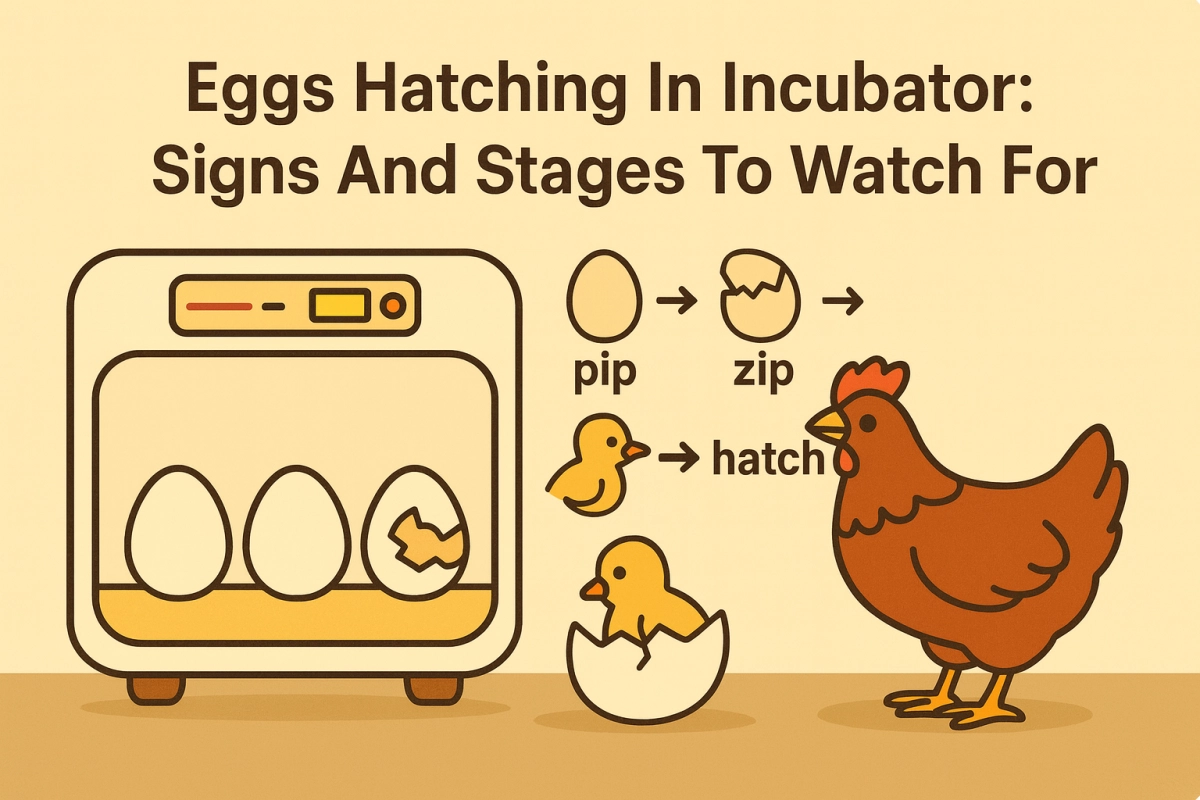
When you watch eggs hatching in incubator, you might feel both excited and nervous. Spotting the right signs at each stage helps you know things are on track. Careful monitoring matters—hatch rates can drop noticeably in artificial incubators if key steps are missed. Turning discipline also matters. Research shows turning 4–6 times/day (or auto-turn every 60–90 minutes) achieves consistently high hatch rates. Understanding the hatching stages not only boosts your chances but also keeps you calm as you wait for those first tiny peeps.
Key Takeaways
In short: set 99.5°F (forced-air) or 100–101°F at egg-top (still-air), hold 45–55% RH to day 18 targeting 11–13% total weight loss, then 65–75% RH at lockdown; wait ~24–36 h after the first external pip and stop at any fresh blood or visible yolk.
-
Turn eggs 4–6 times per day until day 18; then stop and raise humidity for lockdown. Look for internal/external pip signals and avoid opening the incubator.
-
Keep temperature at 99.5°F (forced-air) or 100–101°F at egg-top (still-air). Use two thermometers to verify.
-
Maintain 45–55% RH during days 1–18; control humidity by total weight loss and target 11–13% by day 18. During lockdown, hold 65–75% RH.
Eggs Hatching in Incubator Timeline
Incubating eggs follows a clear timeline that helps you predict key milestones and prepare your setup.
Days 1–18: Turning and Management
Set temperature and humidity first. For the first 18 days, turn eggs at least 4–6 times a day (or use auto-turn every 60–90 min). Turning keeps the embryo from sticking and supports normal development. Candle around days 7 and 10–14 to check for growth.
Tip: “Stable temp & humidity — turn till 18 — lockdown raise humidity — don’t open — don’t help if you see blood.”
Day 18: Lockdown
On day 18, stop turning (remove the turner or stop by hand), lay eggs flat with space between them, and raise humidity to 65–75% RH. Keep the lid closed as much as possible.
Days 20–21: Pipping and Hatching
As hatch day approaches, you’ll notice an internal pip (into the air cell), cheeping, and then the first crack (external pip) in the shell. Most chicks finish within 24–48 h of the first external pip, with some resting up to ~36 h before unzipping.
Quick Reference: Ideal Range
| Factor |
Ideal Range |
Why It Matters |
|---|---|---|
| Temperature |
99.5°F (37.5°C) (forced-air); 100–101°F at egg-top (still-air) |
Keeps chicks strong and hatching on time |
| Humidity |
45–55% RH (days 1–18); 65–75% RH (last 3 days) |
Prevents shrink-wrap or sticky chicks; supports safe hatch |
| Candling |
Day 7 (veins), Day 14–18 (air cell growth) |
Shows embryo health and air cell drop |
| Egg Turning |
4–6 times/day; stop at day 18 |
Lets chick get into hatching position |
�� Remember: Most chicks will hatch on their own if you keep the incubator closed and conditions steady. If you see blood or the chick seems stuck, wait and watch.
Incubator Settings
Temperature: Still-Air vs. Forced-Air
For a successful hatch, set 99.5°F (37.5°C) in forced-air incubators. For still-air incubators, measure at egg height and aim for 100–101°F (37.8–38.3°C). Still-air can have a top-to-bottom difference up to ~7°F, so verify with two thermometers and check multiple spots (egg-top/center/corner). A spread of ≥0.5°F warrants tuning fan/vents before setting.
Tip: Keep temperature steady for all 21 days.
Humidity: Weight Loss and Control
Control humidity by tracking total weight loss. Maintain 45–55% RH during days 1–18 and target 11–13% total weight loss by day 18. During lockdown, raise humidity to 65–75% RH. Proper moisture loss grows the air cell and supports safe pipping and zipping.
-
Weigh eggs at the start and again every 5–7 days (or at least by day 18).
-
If weight loss is below target, lower RH; if above, raise RH.
-
Adjust water trays/sponges and avoid frequent lid-opening.
Ventilation and Lid Management
Chicks need increasing oxygen near hatch. Increase vent opening gradually through lockdown(e.g., open ~30% → 60% in steps)while holding 65–75% RH. Avoid sudden drafts that crash humidity. Keep the lid closed unless absolutely necessary.
�� Alert: Do not open the incubator during lockdown unless required. Wait until most chicks have hatched and dried.
Waiting and Safety
Pip to Hatch Timing
Once you see an external pip, the real waiting begins. Most chicks take about 12–24 hours from pip to hatch; some need up to ~48 hours. You may hear cheeping or see the shell move—resting between efforts is normal. Keep conditions steady and the lid closed.
Rule of thumb: wait ~24–36 h after the first external pip; stop at any fresh blood or visible yolk; maintain ≥65% RH during this window.
Warning Signs
Some problems can show up during incubation or hatching. Knowing these signs helps you act fast and protect your hatching chicks. Here are common warning signs and what they might mean:
-
Eggs that never develop may come from infertile parents or poor nutrition.
-
No signs during candling by day 7 could mean overheating or an incubator issue.
-
Rotten eggs often point to bad temperature or poor ventilation.
-
Chicks fully formed but dead without pipping usually indicates low humidity.
-
Eggs pipped but chick dead in shell can result from low humidity or not enough air.
-
Sticky chicks often result from low temperature and high humidity.
-
Dry shell sticking to chicks means humidity was too low at hatch time.
-
Chicks hatching too early with bloody navels suggest high temperature.
-
Rough or poorly healed navels can come from temperature swings or excess humidity.
-
Chicks that are too small often had low humidity.
-
Large, mushy chicks may be from low temperature or poor airflow.
-
Weak chicks sometimes mean the parent birds had disease or poor nutrition.
-
Chicks with short down can be from high temperature and low humidity.
-
Gasping chicks show temperature was too low.
-
Delayed hatch often happens if the temperature was too high in the last days.
-
A slow, drawn-out hatch can be from high temperature or bad egg storage.
-
Crippled chicks may have genetic issues.
�� Alert: If you see blood vessels, an unabsorbed yolk, or lots of blood, stop all help. Raise humidity and wait.
After Hatch Care
Drying in Incubator
After hatching, chicks look wet and tired. Leave them in the incubator for 4–8 hours to dry and rest. If many hatch together, you can wait up to 12–24 hours before moving. Opening too early can chill them or crash humidity for late hatchers.
�� Tip: Open the incubator only when most chicks are dry and no new eggs are pipping.
Moving to Brooder
When chicks look fluffy and active, it’s time to move them. Pre-warm the brooder to 95°F (35°C), then reduce by 5°F (~3°C) each week. Use shallow water with marbles/stones and place starter feed so chicks can find it easily.
Humidity or Temp Swings
Big changes in humidity or temperature can cause problems. Too dry: chicks may stick to the shell; too wet: sticky chicks or drowning risk. Fluctuations reduce hatch rates and chick vigor. Keep targets steady and track weight loss.
| Condition |
Effect on Hatch Rates |
Additional Findings |
|---|---|---|
| Humidity matches weight-loss targets |
Improved outcomes vs fixed % alone |
Prevents both shrink-wrap (too low) and sticky chicks/navel issues (too high) |
| Low Humidity |
Decreased hatch rates |
Excessive weight loss; increased embryonic mortality |
| Fluctuating Temperature/Humidity |
Unpredictable development |
Smaller or weaker chicks possible; keep parameters steady |
Keep your incubator steady. Use two thermometers and at least one hygrometer. Aim for 11–13% total egg weight loss by day 18 for best results.
Sticky or Stuck Chicks
Sticky or stuck chicks appear gooey or unable to move—usually from too much humidity during incubation. Keep RH in range and work by the air-cell side only if you must assist. Moisten membranes gently; never peel large shell pieces at once.
Quick Reference Card
| Parameter |
Recommended |
|---|---|
| Days 1–18 RH |
45–55% RH; adjust to meet weight-loss targets |
| Lockdown RH |
65–75% RH |
| Weight Loss by Day 18 |
Target: 11–13% total egg weight lost |
| Egg Turning |
4–6 times/day; stop at day 18 (auto-turn every 60–90 min) |
| Lockdown |
Day 18: stop turning, raise humidity, gradually open vents |
| Pip to Hatch |
12–24 h typical (up to ~48 h) |
| Post-Hatch Holding |
Leave chicks in incubator 4–8 h to dry (up to 12–24 h if many hatch) |
| Brooder Temp (Week 1) |
95°F; lower by 5°F each week |
Common Mistakes to Avoid
-
Opening the incubator during lockdown (days 18–21).
-
Forgetting to turn eggs before day 18.
-
Using only one thermometer/hygrometer.
-
Not tracking egg weight loss for humidity control.
-
Helping chicks too soon when you see blood or unabsorbed yolk.
Keep this card close! You’ll feel more confident and your chicks will thank you. ��
0 Comments