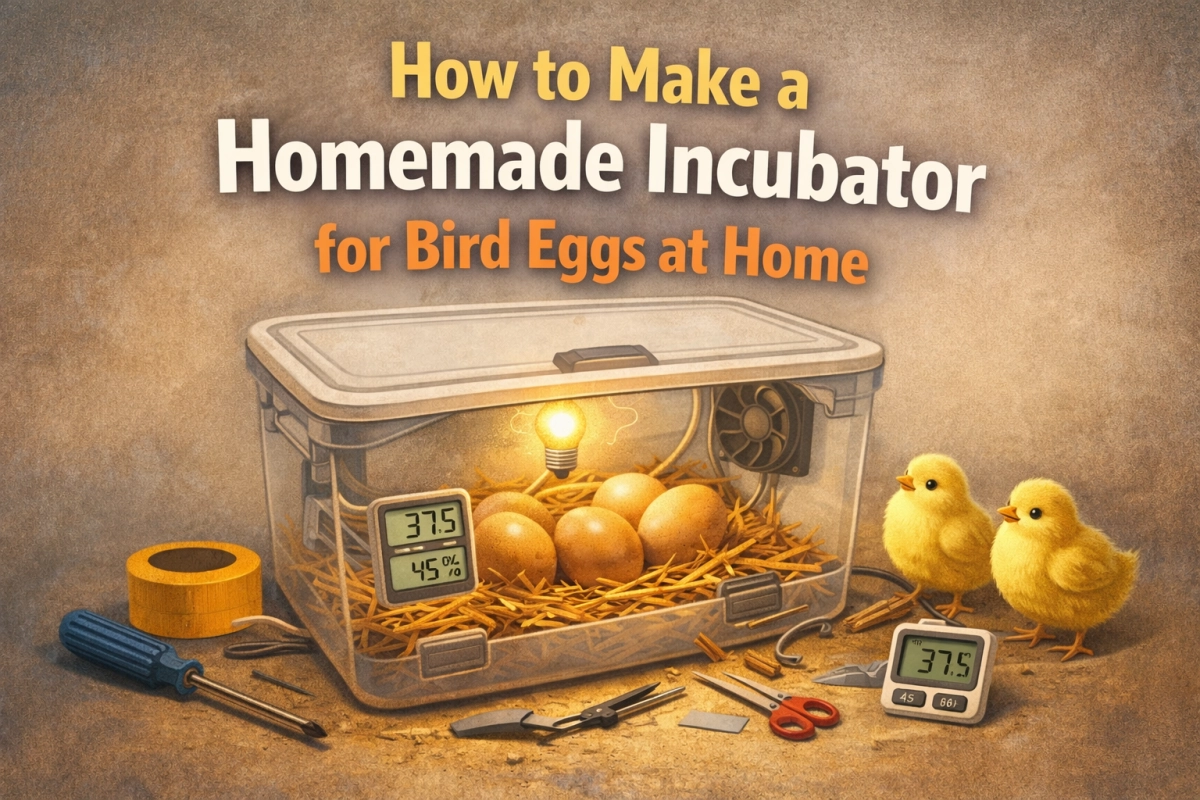
You can build a homemade incubator for parrot and pigeon eggs at home, but you should treat it like a steady little job, not a quick craft. If you want to see what a purpose built setup looks like, you can browse our bird egg incubators. You can still DIY, and you can still learn a lot, but you should start small and keep your numbers steady. You can also browse our bird egg incubator collection when you want a ready setup.
Key Takeaways
- You should start with a small batch, so you can learn the pattern without panic. You should run the incubator empty for 24 hours before you trust it with eggs. You should measure temperature at egg height. You should use humidity as a guide, but you should trust egg weight loss more than one cheap meter. You should turn on a routine, because missed turns add up fast.
Does a Homemade Incubator Work for Bird Eggs?
You should keep it simple. You should keep temperature steady. You should keep humidity on track. You should keep turning on a schedule.
DIY for Small Batches
Homemade incubators work best when you have a small number of eggs. If you try to hatch too many at once, it gets hard to keep the temperature and humidity even. Parrot and pigeon eggs are smaller than chicken eggs, so they need more careful control. Some studies show that homemade incubators can keep eggs warm and moist enough for hatching. They also work well as backup incubators if your main one stops working or if you want an eco-friendly option.
Barn note: Start with just a few eggs. This makes it easier to check on each one and change the settings if you need to.
Here is a quick look at what experts have found:
| Study Title |
Key Findings |
Purpose |
|---|---|---|
| University Extension hatching basics |
Steady temperature, steady humidity, fresh air, and regular turning support healthy embryo growth in bird eggs. |
To give practical starting points and handling steps for home hatching. |
Four Key Controls for Hatching
You need to pay close attention to four main things when using a homemade incubator:
- Temperature: Keep the eggs warm. You should use a thermostat if you can. Even small swings in temperature can hurt the chicks.
-
Humidity: Eggs need the right amount of moisture. Too dry or too wet can cause problems when the chicks try to hatch.
-
Ventilation: Fresh air is important. Good airflow stops harmful gases from building up.
-
Egg Turning: Turn the eggs several times a day. This helps the chicks grow evenly inside the shell.
If you miss any of these steps, you might see problems like uneven hatching, weak chicks, or eggs that do not hatch at all. Here are some common challenges you might face:
| Challenge |
Impact |
|---|---|
| Temperature swings |
Can cause failed hatches or late dead chicks. |
| Uneven heating |
Makes some eggs hatch while others do not. |
| Humidity issues |
Chicks may struggle to breathe if moisture is not right. |
| Rough handling |
Cracks or air cell problems from opening the incubator too often. |
| Inappropriate equipment |
Some farm style incubators do not fit small parrot or pigeon eggs well. |
You can succeed with a homemade incubator if you watch these four controls closely. You should start small, check your eggs often, and learn as you go. Every batch teaches you something new.
DIY Homemade Incubator Build
Building your own homemade incubator can feel like a science project, but you can do it with everyday materials. You just need to follow a few steps and pay close attention to how everything works together. You should let’s break it down so you can get started with confidence.
Parts List and Safe Layout
You need a few key items to make a safe and effective homemade incubator for bird eggs. Here is what you should gather:
-
Container: Pick a sturdy box or cooler. Make sure it has good insulation and enough space for your eggs.
-
Heater: Use a small heating element, like a reptile heat lamp or a ceramic bulb. Choose the wattage based on your box size.
- Thermostat: This part keeps the heat steady. You should set a fan based box close to 100.0°F (37.8°C) as a common starting point. You should start many parrots closer to 98.6–98.8°F (37.0–37.1°C), so you should check your species guide.
-
Humidity control: Place a shallow dish of water inside. Add a sponge if you need to boost humidity, especially near hatching time.
-
Fan: A small computer fan helps move air gently. This keeps the temperature and humidity even.
-
Vents: Make a few small holes in the box for fresh air. Good airflow stops condensation and keeps the eggs healthy.
-
Thermometer and hygrometer: Put these at egg height to check temperature and humidity. Calibrate them before you start.
-
Egg Turner or manual turning routine: You can turn eggs by hand or use a simple turning device.
-
Candler: Use a small flashlight to check if the eggs are developing.
Barn note: Place the thermostat probe and thermometer right at the level of the eggs. This gives you the most accurate readings.
Here is a quick table to help you organize your setup:
| Part |
Purpose |
Placement Tip |
|---|---|---|
| Container |
Holds eggs and keeps heat in |
You should use insulation, avoid leaks |
| Heater |
Provides warmth |
Away from eggs, not direct |
| Thermostat |
Controls temperature |
Probe at egg height |
| Humidity control |
Keeps moisture level right |
Near eggs, not touching |
| Fan |
Circulates air |
Gentle airflow, not direct |
| Vents |
Allows fresh air |
Small holes, spaced out |
| Thermometer/Hygrometer |
Monitors conditions |
At egg height |
| Egg Turner/Candler |
Turns eggs/checks development |
Easy access |
Steps to Reduce Hot Spots and Drafts
You want every egg to get the same warmth and humidity. Here is how you can avoid hot spots and drafts:
- You should put the fan in a spot where it moves air gently. Don’t let it blow straight onto the eggs.
- You should use shelves or egg trays that lift the eggs off the bottom. This helps air move all around.
-
Space out the eggs so they don’t touch each other. This keeps the temperature even.
- Make sure the heater isn’t too close to any one egg. If you see one area getting hotter, change the fan or move the heater.
- You should check for drafts near vents. If you feel cold air, cover the vent with a thin cloth or change its size.
Note: Always test the airflow with your hand before adding eggs. If you feel a strong breeze, move the fan or add a barrier.
If you notice condensation on the walls, open a vent slightly. If the eggs feel cooler on one side, try moving the fan or adding another small vent. You want gentle, steady air—not gusts.
24-Hour Dry Run Test
Before you put any eggs in your homemade incubator, run a dry test for 24 hours. This step helps you spot problems early.
- You should set up everything as if you were ready to hatch eggs.
- You should turn on the heater, fan, and thermostat. Fill the water dish and place the thermometer and hygrometer at egg height.
- You should watch the temperature and humidity for a full day. Write down any changes you see.
- If the temperature goes up and down, change the thermostat or move the heater. If humidity drops, add more water or a bigger sponge.
-
Fix any drafts or hot spots you find. Make sure the readings stay steady.
Alert: Don’t skip the dry run. It helps you learn how your homemade incubator works and gives you time to fix issues before you risk your eggs.
If you see big swings in temperature or humidity, try changing the water dish size, moving the fan, or sealing small gaps in the box. You want the numbers to stay close to your target for the whole 24 hours.
Once you finish the dry run and everything looks stable, you’re ready to add your eggs. You should keep checking the readings every few hours, especially during the first day. This helps you catch problems early and gives your eggs the best chance to hatch.
Incubation Temperature Guide
You should treat temperature like the heartbeat of your incubator. You should keep it steady, because big swings can stall growth even when the average looks fine.
Starter Ranges for Parrots and Pigeons
You can use a simple starting point. Many parrot eggs do well around 98.6 to 98.8°F (37.0 to 37.1°C). Many pigeon eggs do well around 99.5 to 100.0°F (37.5 to 37.8°C). You should still check your species guide, because timing and shell thickness can change the plan.
| Bird Type |
Temperature Range (°F) |
Temperature Range (°C) |
|---|---|---|
| Parrots (many species) |
98.6 – 98.8 |
37.0 – 37.1 |
| Pigeons |
99.5 – 100.0 |
37.5 – 37.8 |
You can use these numbers as a starting point, but you should match them to your airflow. You should aim lower when a fan moves warm air evenly. You should aim a bit higher when you have still air, because heat can sit near the lid while eggs stay cooler. Many still air boxes need about 102°F (38.9°C) at egg height to match a fan based setup.
Barn note: Small changes in temperature can make a big difference. You should try to keep the temperature steady, with no big swings.
Probe Placement and Quick Checks
You should place your probe at egg height, not against the lid and not on the floor. You should also check for hot spots by moving the probe to a few corners during your 24 hour dry run, because a small box can hide one hot corner that cooks eggs slowly.
Here is a quick checklist for daily temperature checks:
-
Look at the thermometer at least three times a day.
-
Write down the temperature each time.
- If you see a change of more than 0.5°F, change the heater or check for drafts.
-
If you use a digital thermostat, test it with a second thermometer to make sure it is accurate.
If you ever feel unsure, trust your notes and make small changes. Keeping a log helps you spot problems early.
Remember, temperature, humidity, and egg turning are the three main things that decide if your eggs will hatch. Stay patient and keep checking. You are giving your eggs the best start possible!
Managing Humidity in a Homemade Incubator
You should think of humidity like the feel of a warm, steamy bathroom. You do not need fog. You need enough moisture so the inner membrane does not dry and cling during hatch.
Humidity Ranges for Parrots and Pigeons
You can start near 50 to 52% RH for many parrots, and near 55 to 60% RH for many pigeons. You should not treat these as magic numbers. You should treat them as a starting line.
- Parrot eggs do best at about 50% humidity during most of hatching.
-
Pigeon eggs usually need a similar range, around 50–55% humidity.
-
As hatching time gets close, you should raise the humidity to help the chicks break free.
You can use a hygrometer to check the humidity inside your homemade incubator. You should place it at the same height as your eggs for the best reading.
Weight Loss Method for Calibration
You should use egg weight loss to confirm your humidity. Most healthy hatches land around 13 to 15% total weight loss by hatch day, and that number tells you more than one jumpy hygrometer.
-
Weigh each egg before you put it in the incubator. Write down the number.
- Weigh the eggs every few days. You should keep a chart.
-
Healthy eggs should lose about 13–15% of their starting weight by the time they hatch.
-
If eggs lose weight too fast, add more water or a bigger sponge to raise humidity.
-
If eggs lose weight too slowly, open a vent or use a smaller water dish to lower humidity.
This method helps you change humidity based on what your eggs actually need. It’s a simple way to give your chicks the best chance.
Lockdown Humidity and Lid Rule
You should raise humidity for the last 2 to 3 days, and you should keep the lid shut as much as you can. You should aim for at least 60 to 65% RH in lockdown, and many pigeon setups do well closer to 65 to 70% RH.
- You should raise humidity to 65–70% when you see the first signs of hatching.
-
High humidity helps chicks move and breathe as they break out of the shell.
- You should keep the lid closed during lockdown. Opening the incubator can drop humidity fast and make it harder for chicks to hatch.
Barn note: If you need to add water, do it quickly and gently. You should try not to let the warm, moist air escape.
Managing humidity takes practice, but you’ll get better with each batch. You should watch your eggs, keep notes, and change as you go. You’re learning real skills that help your birds thrive!
Turning Eggs by Hand
You should turn eggs because the embryo needs to stay centered and well fed by the yolk. You should handle each egg like a warm grape. You should move slow and steady. If you want turning to happen while you sleep, you can use our Automatic Egg Incubator 3 Trays for Birds and Quail.
Simple Turning Routine
You should turn on a rhythm that fits your real day. You should turn often enough to avoid long gaps, and you should stop turning a few days before hatch so the chick can line up to pip.
You should aim for 4 to 6 gentle turns each day. You should spread the turns out, so the embryo does not sit in one spot for long. If you know your day will get busy, and you want turning to happen even when you are asleep, you can look at our Automatic Egg Incubator with 3 trays for birds and quail.
Here is a routine you can follow:
- You should wash your hands before touching the eggs.
- You should mark one side of each egg with a pencil. This helps you remember which way to turn.
- You should turn each egg gently, rolling it from one side to the other.
- You should try to turn the eggs five to seven times a day. You should spread the turns out so the eggs do not sit in one position for too long.
- You should keep a chart or checklist to track your turns. This helps you stay organized.
Barn note: Use a soft towel or egg tray to keep eggs from rolling too far or getting bumped.
When to Stop Turning (Parrots vs. Pigeons)
You need to stop turning the eggs at the right time. This helps the chick get ready to hatch.
- You should watch for signs that hatching is close. The air space inside the egg gets bigger, and the egg may look different.
-
Some people move eggs to a special hatcher when these changes appear.
- You should stop turning parrot and pigeon eggs about two days before you expect them to hatch.
-
For most parrot eggs, this means stopping on Day 16–28, depending on the species.
-
For pigeon eggs, stop turning on Day 15–17.
-
This gives the chick time to settle and get ready to break out of the shell.
If you follow these steps, you give your eggs the best chance to hatch strong and healthy chicks. Turning eggs by hand is easy to learn, and you will get better with practice. Temperature, humidity, and egg turning are the three main things you control. Stay patient and keep notes. You are building real skills with every batch!
Hatching Timelines
You should use timelines as a map, not as a stopwatch. I know day counting can make you tense, but your temperature history matters more than one calendar number.
Pigeon Egg Days
Many pigeon eggs hatch in about 17 to 19 days when conditions stay steady. You should plan to stop turning around day 15, because the chick needs time to settle into hatch position.
-
Most pigeon eggs take about 18 days to hatch.
-
You must keep the eggs warm and protected the whole time.
-
Good temperature, steady humidity, and regular egg turning help the embryos grow well.
Barn note: Write the date you start incubating on your calendar. This makes it easy to track the days and know when to stop turning the eggs.
If you notice the eggs are not hatching by day 19 or 20, check your temperature and humidity logs. Sometimes small changes can slow things down. Stay patient and keep watching.
Parrot Egg Ranges
Parrot hatch time depends on species. Budgies often hatch around 18 days, cockatiels often fall around 18 to 21 days, lovebirds often fall around 21 to 23 days, African Greys often fall around 28 to 30 days, and many macaws sit around 26 to 27 days.
| Parrot Species |
Typical Incubation Days |
|---|---|
| Budgerigar (Budgie) |
18 |
| Cockatiel |
18–21 |
| Lovebird |
21–23 |
| African Grey |
28–30 |
| Macaw |
26–27 |
You should always check the expected range for your parrot species. Most small parrots hatch in about 18–21 days. Larger parrots, like African Greys and Macaws, can take up to 30 days.
�� Note: If you’re not sure about your species, use the higher end of the range and keep watching for signs of hatching.
No matter which bird you have, remember that temperature, humidity, and egg turning are the three keys to success. You should keep your records, stay alert, and you’ll learn more with every batch you hatch!
Homemade Incubator Troubleshooting & Alternatives
You should treat troubleshooting like a calm walk through the barn. You should change one thing at a time, and you should give the box time to settle before you change it again. You can still keep DIY simple, but you can also keep a steady backup from our bird egg incubator collection.
Short-Term Substitutes at Home
Sometimes your homemade incubator stops working. You might need a backup fast. You can use things from around your house to make a short-term incubator. Here is a table that shows what you can use and why:
| Household Item |
Purpose |
|---|---|
| Cooler |
Acts as the main incubator box |
| Thermostat |
Controls the temperature |
| Low Wattage Incandescent Lightbulbs |
Provides gentle heat |
| Computer Fan |
Circulates air inside |
| Phone Charger |
Powers the fan |
| Adhesive |
Holds parts in place |
| Extension Cord |
Supplies power safely |
These items help keep eggs warm for a short time. These setups may not keep temperature or humidity steady. You need to check the eggs often.
Power Outage and Cold Egg Actions
Power outages can happen at any time. If your incubator loses power, you must act fast. Here is what you can do:
| Emergency Step |
Description |
|---|---|
| Insulation |
Wrap towels or blankets around the incubator. You should put it on a towel for warmth. Add warm water bottles if you can. |
| Move to a Warmer Room |
Take the incubator to a warmer spot in your house. Stay away from cold or drafty rooms. |
| Safe Heat Sources |
You should use warm water bottles or chemical warming pads. You should watch the temperature closely. |
| Monitor Conditions |
You should check temperature and humidity often. Adjust to stay close to your target. |
| Resume Egg Turning |
When power comes back and things are stable, start turning eggs again. |
| You should check Egg Health |
Candle the eggs to see if they are alive. Remove any spoiled eggs. |
��️ Barn note: Most hatching failures happen from temperature drops, humidity swings, or missed egg turning. Stay calm and act quickly.
Safe Handling Before Incubation
How you handle eggs before hatching is very important. You can lower problems by following these steps:
-
Collect eggs at least twice a day to keep them clean.
-
Separate dirty, cracked, or thin-shelled eggs right away.
-
You should store eggs only for a short time before you start incubation. You should keep them in a clean, cool room, away from sun and sudden temperature swings. You should not refrigerate eggs unless your species guide tells you to.
- You should wash your hands before touching eggs. Only wash eggs if you really need to.
- You should check each egg for defects by looking and gently feeling.
- You should use a “first in, first out” system so older eggs get used first.
You should keep hands, tools, and the incubator clean, because dirty shells can carry germs that harm the embryo.
When to Consider a Commercial Incubator
You should switch to a purpose built incubator when you cannot keep a steady line on temperature and humidity, or when you are caring for valuable eggs that you cannot replace. You can start by browsing our bird egg incubators, and you can pick the level of control that fits your birds and your schedule.
Want less stress and more success? You should check our Egg Incubator category page for models with auto-turn and humidity control. You’ll find options that make hatching easier and more stable—great for beginners and anyone who wants to give their eggs the best chance.
Every batch teaches you something new. Eggbloom helps you learn, troubleshoot, and grow as a bird breeder. You should keep focusing on temperature, humidity, and egg turning—these three things matter most for hatching success!
You’ve learned how to build, watch, and care for eggs in a homemade incubator. Here is a quick recap of the main steps:
- You should set up your incubator and clean it well.
- You should place eggs at room temperature and turn them several times each day.
- You should watch temperature, humidity, and egg turning closely.
- You should stop turning eggs before hatching and raise humidity.
Remember:
-
Each bird species needs its own settings.
- You should check your readings often and fix problems right away.
- You should keep a log and change as you learn.
Every batch teaches you something new. If you want more reliable results, you can try a commercial incubator in the future. Don’t be afraid to share your story—your tips can help others succeed. Give it a try and enjoy the journey! ��
FAQ
How often should I check the incubator each day?
You should check your incubator at least three times a day. Look at the temperature and humidity. Turn the eggs if you do it by hand. Write down what you see. This helps you catch problems early.
Can I use a regular light bulb as a heat source?
Yes, you can use a low-wattage incandescent bulb for heat. Make sure it does not touch the eggs. You should watch the temperature closely. Some bulbs get too hot, so test before adding eggs.
What if the humidity drops too low?
Add more water or a damp sponge inside the incubator. You should check the hygrometer at egg height. If you see the eggs losing weight too fast, raise the humidity. You should keep the lid closed as much as possible.
Do I need to turn the eggs at night?
Turning eggs at night helps the chicks develop evenly. If you miss a turn, do it as soon as you remember. You should try to turn the eggs five to seven times in 24 hours for best results.
Why didn’t my eggs hatch?
Most hatching problems come from temperature, humidity, or missed egg turning. Review your notes and check your setup. Stay patient and try again. Each batch teaches you something new!
0 Comments