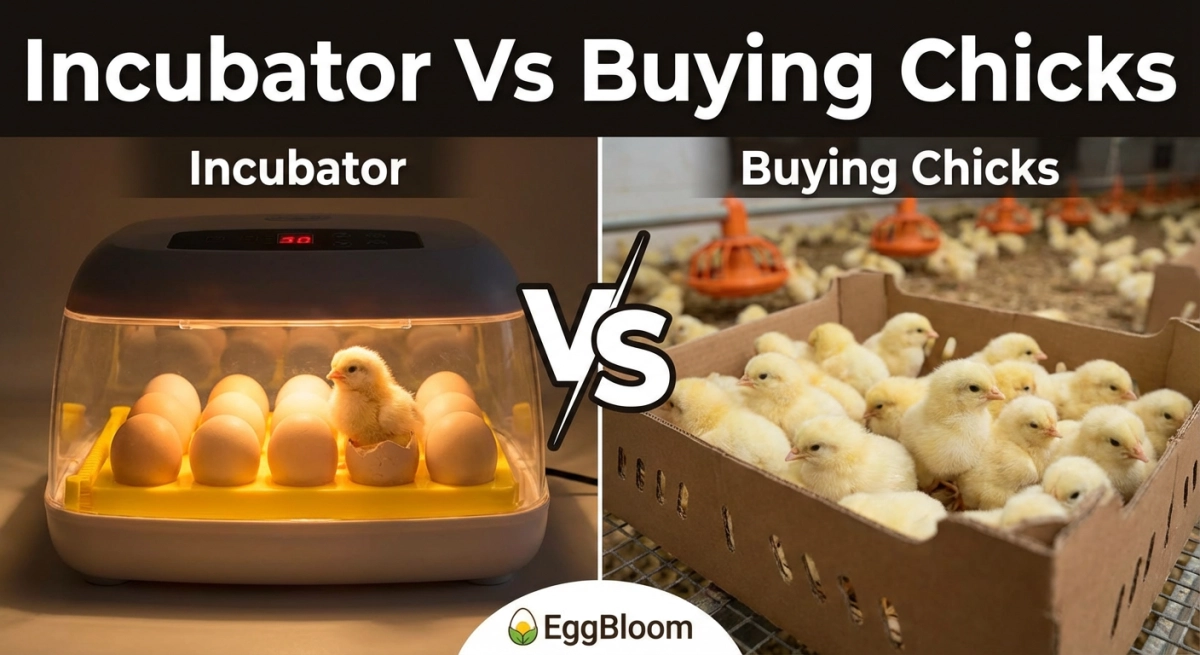
When you weigh an incubator vs buying chicks, you are not just picking a product. You are choosing what the next few months on your place will feel like. Some keepers want a small, steady group of hens that lay eggs and stay out of trouble. Others want to watch chicks fight their way out of the shell and share that moment with kids or students. You might care most about money. Or time. Or how much risk and hands-on work you can live with. Your local rules and your yard size also matter. Both paths can work well. They are just very different journeys. If you already know that incubating sounds right for you, you can also look over Eggbloom’s egg incubator options while you read.
Key Takeaways
-
Start with your main goal. If you want a slow, teachable project where everyone watches the full life cycle, an incubator can be a great fit. If you want quiet hens in your yard as soon as you can, buying chicks is usually the smoother path.
-
City rules can make the choice for you. Many towns limit flock size or do not allow roosters at all. In those places, buying sexed pullets helps you stay legal and keep the peace with neighbors.
-
An incubator has a higher upfront cost and needs steady care. Buying chicks spreads your cost out in birds, not in gear, and gets you closer to eggs with fewer unknowns.
-
Incubating eggs means daily checks, watching temperature and humidity, and accepting that some eggs will never pip. Buying chicks skips the hatch and puts your time into brooding and growing them out.
-
If you dream about rare breeds or building your own line over time, an incubator opens doors that simple chick orders cannot. If you just want a friendly, reliable backyard flock, hatchery chicks usually do the job with less risk.
Incubator vs Buying Chicks: Key Decision Points
What Are You Really Choosing?
When you put incubator vs buying chicks side by side, you are really choosing how much control and uncertainty you want. You are also choosing where your work sits. With an incubator, most of the work lives in the first three weeks. With chicks from a hatchery or feed store, most of the work lives in brooding and raising.
It may help to picture a few real backyards and small farms. These are the kinds of people I sit down with at the fence and talk through this same choice every spring.
-
You live in town and want a quiet flock of egg layers.
Your city may cap how many chickens you can keep. Many places allow hens but ban roosters because of the noise. If you hatch your own eggs, you cannot pick the sex ahead of time. You may end up with roosters you are not allowed to keep. Buying chicks as sexed pullets gives you a much better shot at a hen-only flock and keeps you on the right side of local rules. -
You want a family or classroom project around life cycles.
Hatching in an incubator is hard to beat for teaching. Kids see dark eggs turn into moving shadows, then hear the first faint peeps. It is powerful. It is also real farm life. Not every egg will hatch. Some chicks will struggle. You must decide if your group is ready to see both the joy and the losses. Buying chicks brings the cute stage with much less stress, but you skip the slow build of those 21 days. -
You care about rare breeds or your own breeding program.
Many special breeds never show up as sexed chicks at the feed store. Some hatcheries sell them only as hatching eggs. An incubator lets you bring those lines to your place. If you already keep a rooster, you can also hatch from your own flock and slowly shape the traits you care about: hardiness, color, egg size, or temperament.
Before you go too far in either direction, take a close look at your local rules. Backyard chickens are legal in more places every year, but the details still vary a lot. Rules can touch your coop, your flock size, and even how close your birds can be to your neighbor’s fence. If you want a deeper look at how fast these rules are changing, Eggbloom’s update on backyard chicken laws in 2025 is a good place to start.
| Regulation Type |
What It Might Mean for You |
|---|---|
| Chicken Coop Rules |
Your town may set basic standards for coop size, cleanliness, and how you protect birds from predators. |
| Permits |
Some places ask you to apply for a permit, pay a fee, or get written approval from neighbors before you keep chickens. |
| Coop Location |
Setback rules can tell you how far the coop must be from property lines, streets, or nearby homes. |
| Butchering |
Many city codes do not allow home butchering, or they restrict it to certain zones or conditions. |
| Selling Eggs |
You may need a license or to follow basic food safety rules before you sell eggs to friends or at a market. |
| Nuisance Laws |
Noise, smell, and flies can all fall under nuisance rules, even if chickens themselves are allowed. |
| Other Local Details |
Some towns add rules about feed storage, manure piles, or “trial permits” that let you keep birds for a short test period. |
Tip: Do not guess on the rules. Check your city or county website or call animal control before you spend money. A ten-minute call can save you the pain of rehoming birds later.
Pros and Cons Overview
You may still wonder if incubator vs buying chicks is really that big a difference. On paper they both give you chickens. In real life they feel very different. One leans more toward “project.” The other leans more toward “plug-and-play.”
Hatching Chicks with an Incubator
| Advantages |
Trade-Offs |
|---|---|
| You see the full 21-day process from egg to chick. |
You must buy and learn to run the incubator, not just “plug it in and forget it.” |
| You can hatch rare breeds or eggs from your own flock. |
You cannot choose only hens. Roosters will show up in the mix. |
| You can run smaller or larger batches as your space allows. |
You carry the risk that shipped eggs or handling mistakes lower your hatch rate. |
| Once you own a good incubator, you can use it season after season. |
The first season can cost more per chick until you spread the incubator cost across several hatches. |
-
You learn more about eggs, embryos, and what chicks need before they even hatch.
-
You get a stronger sense of control over timing and batch size, but you also feel the worry when things do not look perfect.
-
You should go in knowing that even with care and good equipment, a few eggs will stay quiet all the way through day 21.
Buying Chicks
| Advantages |
Trade-Offs |
|---|---|
| You skip the hatch and start with live, fluffy chicks. |
You do not get to see the inside steps of the life cycle. |
| You can order sexed pullets to tilt the flock heavily toward hens. |
Sexing is not perfect. A “pullets only” order can still hide a rooster or two. |
| You save time. There is no 21-day wait before brooding begins. |
Some hatcheries have minimum order sizes that are larger than you really want to keep. |
-
You move straight into brooding, which is still work, but it is simpler and more forgiving than managing an incubator.
-
You can get strong, well-started chicks if you choose a good hatchery and time your order around weather.
-
You give up some choice in genetics and timing in exchange for a smoother start.
Note: If your top goal is a calm little group of hens and your town frowns on roosters, buying sexed chicks is usually the kindest and least stressful choice. If you feel drawn to the slow magic of the hatch, an incubator can be worth the extra learning curve.
When you look at incubator vs buying chicks, try not to chase the “perfect” option. Think instead about what kind of work you are willing to do and what kind of story you want to tell about how your flock began.
How Incubators Work for Backyard Flocks
Types of Incubators and Setup Basics
When you first shop for an incubator, the choices can feel like alphabet soup. The good news is that for a small flock, you really only need to understand a few big ideas. Some models turn the eggs for you and hold a steady temperature with a fan. Others are simpler boxes where you turn eggs by hand and watch the readings yourself.
A still-air incubator has no fan. Warm air rises and cool air sinks, so the temperature can be a little higher at the top than down by the floor of the unit. A forced-air incubator uses a small fan to move air around. That fan helps keep the temperature more even from one egg to the next. Many backyard keepers find forced-air units easier to manage, especially for a first hatch.
Here is a simple look at how different home incubators often compare in feel and use, not just in marketing terms:
| Feature |
Hova-Bator |
Little Giant |
|---|---|---|
| Capacity (eggs per batch) |
Good for small to medium clutches for a backyard flock. |
Can hold more eggs at once for larger hatches. |
| Temperature Control |
Simple manual controls that work well once dialed in. |
Digital readouts and alarms that can warn you when things drift. |
| Humidity Management |
You add water by hand and watch separate gauges. |
Often includes built-in channels or systems to help hold humidity. |
| Ease of Use |
Friendly for careful beginners who do not mind checking it. |
More features to learn, but those features can save you from mistakes. |
| Price and Value |
Lower upfront cost, a good “first incubator” for many keepers. |
Higher price point, but the extra control can pay off over many hatches. |
| Durability and Cleaning |
Lightweight and easy to wipe down between batches. |
Heavier build that stands up to frequent use if you hatch often. |
| Best For |
Backyard keepers doing one or two hatches a year. |
Small farms or very active hobbyists who hatch many batches. |
You might also see models like the Nurture Right 360 or Brinsea tabletop units mentioned often in forums. These tend to be clear-domed, forced-air incubators with automatic turning. Many people like them because you can watch the full hatch without lifting the lid and dropping humidity.
Daily Care and Common Issues
Once the eggs are set, the incubator becomes a little promise you keep with those shells for three weeks. The work is not hard, but it does ask you to be steady. You check a few simple things every day and avoid the urge to tinker too much when everything looks right.
Here is what backyard keepers usually watch during a standard chicken hatch:
| Aspect |
Simple Guidelines |
|---|---|
| Temperature |
In a forced-air incubator, aim for about 99.5°F at egg level. Small swings up or down can slow growth or cause chicks to pip late or early. Use at least one trusted thermometer instead of only watching the built-in display. |
| Ventilation |
Make sure vents are not fully closed. As chicks grow, they need more fresh air. Open vents a bit more near the end of the hatch without letting big drafts hit the eggs. |
| Humidity |
For days 1–18, many keepers stay in the 45–55% range. In the last three days (“lockdown”), they raise it to around 60–65% to keep the inner membrane from drying and sticking to the chick. |
| Egg Turning |
Turn eggs several times a day for the first 18 days, unless your incubator does it for you. Then stop turning and lay them flat for the last three days so chicks can settle into hatch position. |
Most problems come from slow, quiet drifts instead of big disasters. A room that heats up in the afternoon can push your incubator a little warm if it sits in full sun. A forgotten water channel can let humidity sink too low. A built-in thermometer can be off by a degree if you never check it against another one.
With good local eggs and a decent automatic incubator, many new keepers see about 60–80% of eggs hatch. Shipped eggs are a different story. Rough handling and temperature swings on the road can drop that to somewhere closer to 40–60%, even when you do everything right at home. The numbers improve as you gain experience, but no one gets a perfect hatch every time.
Tip: If the power goes out, keep the lid closed and wrap the incubator in towels to hold the heat. When power returns, double-check temperature with your backup thermometer and let it settle before you make big changes. For a quick humidity boost, add warm water to the channels or place a damp sponge inside without blocking air flow.
Incubating eggs is a little like learning to bake bread. The first loaf may not be pretty, but each attempt teaches your hands and eyes what “right” looks like. You get better by doing, not by staring at numbers alone.
Buying Chicks: What to Expect
Ordering, Shipping, and Arrival
Buying chicks is the faster, simpler route for most backyard flocks. You pick a hatchery or local feed store, choose your breeds, place the order, and then wait for that call from the post office or the “chick day” at the store. It feels straightforward, but there are a few realities that every new keeper should hear ahead of time.
-
Hatcheries work hard to ship strong chicks, but they cannot control the weather or every bump on the truck. Heat waves, cold snaps, and delays are hard on tiny bodies that still live off the last of their yolk.
-
You may open the box and find a few chicks already gone. Many hatcheries add extra birds to help cover that risk and will often credit you if losses are heavy, but it is still a tough sight the first time.
-
Sexing is a skill, not magic. When a hatchery says “about 90% accuracy on pullets,” they mean just that. In a small order you may feel that one surprise rooster much more than the math suggests.
-
Ship dates and arrival times can slide. Postal trucks run late. Sorting centers get backed up. Plan your schedule so someone can go to the post office as soon as the call comes in.
-
Postal services do not guarantee live delivery times. Refunds or replacements usually come from the hatchery, and every hatchery has its own policy. It pays to read those details before you send money.
When your chicks arrive, open the box indoors where it is warm and bright. Move each chick straight under your heat source and gently dip its beak in the water so it knows where to drink. This first hour matters more than any fancy gear you buy.
Sexed Pullets, Vaccines, and Minimum Orders
For most city and suburban keepers, the main perk of buying chicks is the chance to order sexed pullets. That one choice does more than almost anything else to keep roosters out of your coop and complaints out of your mailbox. Fewer surprise roosters also means fewer hard decisions later.
Many hatcheries also offer vaccines, such as Marek’s disease protection, as an add-on when you place your order. That extra step can help your flock handle common threats in crowded or high-traffic areas. The catch is that hatcheries often apply vaccines only when you order a certain number of chicks in one batch.
| Order Detail |
What to Expect |
|---|---|
| Sexed Pullets |
You pay a bit more per chick, but you start much closer to an all-hen flock if local rules do not allow roosters. |
| Vaccination Options |
Hatcheries may only vaccinate batches over a minimum size. That minimum can change with the time of year and the type of birds. |
| Minimum Order Size |
Early in the season, some hatcheries ask for larger orders so chicks can keep each other warm in transit. Later in the year, the minimum often drops. |
If you are new and want help planning the brooder stage, Eggbloom’s guide on caring for baby chicks walks through feed, heat, space, and that first step of teaching chicks to drink and eat.
Incubator vs Buying Chicks: Cost, Time, and Success Rates
Cost and Time Comparison Table
Most people want to know, in plain numbers, what each route is going to cost and how long it will take before the first egg lands in the nesting box. Exact figures change with brands and feed prices, but we can lay out simple ballpark ranges for a small flock of about six hens.
| Method |
Upfront Cost (aiming for ~6 pullets) |
Estimated Cost per Chick |
Time to First Eggs |
Hands-On Work |
Notes |
|---|---|---|---|---|---|
| Incubator |
$60–$150 for a basic home incubator, plus roughly $2–$5 per hatching egg. |
Many keepers end up around $6–$8 per live chick in the first season once they count eggs that never hatch and basic supplies. Costs drop as you reuse the incubator. |
About 21 days in the incubator, plus 5–6 months of growing before laying starts. |
Daily checks on temperature and humidity, egg turning, and then all the same brooder work as bought chicks. |
Other gear (extra thermometers, hygrometers) may add to the first-year cost but help protect your hatch. |
| Buying Chicks |
$4–$5 per straight-run chick, a bit more for sexed pullets or rare breeds. |
Cost per live chick is closer to the sticker price, since the hatch risk is on the hatchery, not on you. Shipping may add a flat fee. |
Chicks arrive at 1–2 days old. Plan on 5–6 months from arrival to first eggs. |
Less “fussy” work. Most of your effort is in brooding and then general flock care. |
Some hatcheries require a minimum of 6 or more chicks per order, especially early in the season. |
-
An incubator can pay off if you plan to hatch again and again, especially with eggs from your own flock or local breeders. The more batches you hatch, the more you spread out that one-time equipment cost.
-
Buying chicks usually wins on simple “first-year money in vs live chicks out,” especially if you only ever plan on one or two small flocks.
-
Both paths still need a good brooder, feed, bedding, and time. The main difference is where you spend your energy: on the shell or on the growing bird.
�� Tip: If you know you want to hatch more than once and you like the idea of fine-tuning your setup, consider a beginner-friendly forced-air model from the Eggbloom incubator lineup. A stable machine takes a lot of guesswork out of those first hatches.
Hatch Rates and Risk Factors
Hatch rate is the question that keeps many new keepers up at night. “How many of these eggs will really turn into chicks?” The honest answer is that it depends on where the eggs come from, how they were handled, and how steady your incubator stays.
-
Fresh local eggs from a healthy flock usually give the best results. With careful handling and a decent incubator, many backyard keepers see somewhere around 60–80% of those eggs hatch.
-
Shipped eggs almost always hatch at a lower rate. Shell damage, jarring, and extreme temperatures along the route mean that 40–60% is a more realistic range in many home setups, even when you do everything right.
-
Stories of “almost 100% every time” usually come from very dialed-in setups with tried-and-true local eggs and many seasons of practice. They are possible, but they are not the baseline for a first hatch.
A few other factors also nudge your numbers up or down. Some you can control. Others you just have to accept and plan around.
| Risk Factor |
What It Means for You |
|---|---|
| Parent Flock Health |
Eggs from well-fed, well-kept hens and strong roosters tend to hatch into stronger chicks that handle stress better. |
| Egg Handling |
Rough handling, dirty shells, and long storage times all lower hatch rates. Clean, gently handled eggs that are set within a week do best. |
| Breed Type |
Some breeds are known to be hardy and easy to hatch. Others are more delicate and may need more careful management to reach the same survival rates. |
| Housing and Brooder Setup |
Draft-free, dry, uncrowded brooders help more chicks live and thrive. Damp litter, crowding, and poor ventilation increase losses after hatch. |
| Water and Feed Access |
Chicks that can easily reach clean water and starter feed from day one stay stronger. Poorly placed drinkers or feeders lead to weak, slow-growing birds. |
| Temperature Swings |
Big swings in incubator or brooder temperature stress chicks and can cause losses. Slight, slow changes are easier on them than sudden drops or spikes. |
When you buy chicks instead of hatching, the hatchery does most of the hard early work. They handle the parent flock, the incubation, and the first sort. You still have to give good brooder care, but you start with birds that have already made it past the most fragile stage.
If you do choose to hatch, give yourself grace. A rough first hatch does not mean you “are bad at this.” It means you are learning. Keep notes. Adjust one or two things at a time. Your hands will catch up to the numbers.
�� Note: A good way to stack the deck for a first try is simple: choose fresh eggs from a healthy local flock and pair them with a steady, forced-air incubator. That one decision often does more for your hatch rate than any fancy trick online.
Which Method Fits Your Situation?
Small Flock with City Rules
If you live in town, the question is not just “What do I want?” It is also “What am I allowed to keep?” Noise complaints and zoning rules can end a chicken dream faster than any fox can. Roosters, in particular, are the usual troublemakers in city limits.
In most cases, keepers in these situations are better off buying sexed pullets from a hatchery or store. That way the odds lean strongly toward hens from day one. Hatching eggs with an incubator can still be done, but you have to be ready with a plan for every extra rooster that pops out of the shell.
| Consideration |
Why It Matters in Town |
|---|---|
| Legal Limits |
Some places cap the number of hens. Others allow no chickens at all without a permit. Roosters may be banned outright. |
| Rooster Noise |
A single crowing rooster can upset a whole block of sleepy neighbors. A surprise rooster from a hatch can force hard choices. |
| Permits and Inspections |
Some cities want to inspect your coop or review your plan. A tidy setup with calm hens is easier to approve than a loud rooster flock. |
| Neighbor Relations |
Clean coops, quiet birds, and a quick heads-up to nearby neighbors go a long way toward keeping everyone happy. |
Tip: Before you order anything, read your local ordinances and talk to the people on the other side of the fence. It is easier to build goodwill now than to repair a sour relationship after a 4 a.m. crow.
Family Learning Projects
Many families and teachers dream about lining kids up in a dark room, turning on a flashlight, and watching red veins glow through a shell. Hatching does that. It turns the incubator into a small window on the inside of an egg. It teaches patience and care in a way no worksheet can.
The trade-off is that real life sneaks in. Some eggs quit halfway through. Some chicks cannot finish the zip. You have to decide ahead of time how you will explain that to the kids and how much they will see. For very young children or for groups that are not ready to see loss, buying chicks and focusing on brooder care might be a better fit.
-
Hatching is great for older kids who can handle both joy and disappointment and are ready to help with daily checks.
-
Buying chicks still teaches responsibility: feeding, watering, cleaning, and gentle handling are all important lessons.
-
If you do choose a full hatch project in a classroom, Eggbloom’s classroom incubation starter guide is written with teachers in mind and can help you plan each step.
Rare Breeds and Breeding Goals
If your heart is set on a certain color egg, a rare feather pattern, or building your own line over time, an incubator is often the better tool. Many rare breeds are sold more often as hatching eggs than as sexed day-old chicks. Breeders can ship you eggs even when you live too far away to pick up birds.
Breeding and hatching your own birds also means you carry more of the health and planning load. You need to watch for inbreeding, cull birds with clear problems, and keep clean, roomy pens. It is very rewarding work, but it is closer to running a small breeding program than just “having a few chickens.”
If you simply want friendly brown egg layers for the family, hatcheries can ship you pullets that meet that need with almost no fuss. If you want to shape your flock over years, an incubator gives you the steering wheel.
When an incubator is not a good fit:
-
Your city bans roosters and you have no clear way to place them if they hatch.
-
You only want four to six hens and do not want to risk ending up with extra birds.
-
Your schedule is packed and you know daily checks on an incubator will quickly become a burden.
The right choice is the one that lets you care well for the birds you bring home, fits your rules, and still lets you enjoy the work. There is no shame in choosing the simpler route if that keeps you in the game longer.
Emotional and Practical Realities
The Experience of Hatching Chicks
Hatching chicks at home feels different from almost any other part of keeping poultry. The house gets a little quieter on day 20 and 21. People move slower around the incubator. You learn the sound of the fan. You start hearing phantom peeps that may or may not be real.
When you candle eggs with a small flashlight in a dark room, you will see more than just a shadow. Healthy eggs often show a web of red veins, like a tiny tree reaching across the inside of the shell. Later on, that dark mass shifts as the chick turns into position. The first real peck can take hours to show up, and then the shell cracks just a hair. The whole room leans in and listens.
Many keepers say they feel more attached to chicks they watched from the egg stage. It is not better or worse. It is simply more intense. You see how much work it takes a chick to get into this world. You also see which ones never quite make it, and that shapes how you think about the birds you raise later.
-
You give more thought to your flock because you have seen how much effort is behind each little life.
-
Kids and adults both learn that caring for animals means showing up every day, not just when it is cute.
-
That deeper bond can be a gift, as long as you also make room to accept the losses when they come.
Managing Stress and Expectations
Hatching is exciting, but it can also tie your stomach in knots. It is easy to stare at the incubator and feel like every tiny change is a disaster. New keepers often want to open the lid “just to check” at the very moment when chicks need the humidity to stay high.
You can make the whole process easier on yourself with a few simple habits. None of them are fancy. All of them help you feel less at the mercy of the numbers on the screen.
-
Use at least one backup thermometer and, if you can, a small separate hygrometer. Trust what several tools agree on, not just one built-in reading.
-
Write down what you do each day. Note any power blips or big weather swings. That way, if the hatch goes badly, you have clues for next time.
-
Once lockdown begins, tell yourself and your family “We do not open the lid.” Watch through the window instead. Chicks can take many hours from first pip to full hatch.
Remember, even people who have hatched for twenty years still have rough batches. A bad hatch does not mean you failed. It means you have one more story and a little more wisdom for the next tray of eggs.
Final Tips: When to Choose Each Option
Quick Decision Checklist
When neighbors ask me whether they should hatch or buy, I walk them through a few simple questions. You can do the same for yourself. Circle the answers that feel most like you, and the better option usually shows up pretty clearly.
-
Do you want control over the hatch itself?
If you want to choose the exact start date, egg source, and clutch size, an incubator gives you that control. Buying chicks means working with the hatchery’s schedule instead. -
Are you ready to invest in equipment?
An incubator, extra thermometers, and small tools cost more at the start. Buying chicks lets you spend that money on the birds and the brooder instead. -
How much daily hands-on work do you want?
Incubators ask for steady, careful attention for three weeks and then all the usual brooder work. Chicks shift more of that effort into brooding and general care. -
Does your town allow roosters?
If the answer is no, sexed pullets are often the safest road. An incubator cannot promise you hens only, no matter how careful you are. -
Are rare breeds or long-term breeding goals important to you?
If yes, an incubator is a strong tool for that job. If no, a short list of hardy hatchery breeds will serve a backyard flock very well. -
Are you brand new to chickens?
If you are starting completely from scratch, it often helps to first learn the basics of housing and daily care. Eggbloom’s beginner’s guide to backyard chickens is a good next read if you want that bigger picture.
�� Tip: Put your answers on paper. When you see “no roosters, limited time, want eggs soon” written in ink, the right choice usually feels less confusing.
Next Steps for New Keepers
Once you decide on incubator vs buying chicks, the real work begins. Both paths still end with young birds in a brooder and, later, full-sized hens in your yard. Getting ready now will make life easier on both you and your flock.
-
Set up a safe brooder before eggs go into the incubator or chicks ship. Make sure you have a heat source, a draft-free space, and enough room for everyone to move around.
-
Choose a good starter feed and simple, low spill feeders and waterers. Teach chicks where feed and water are on day one by gently dipping beaks and tapping at the feed.
-
Use a safe bedding, such as pine shavings, and keep it dry. Avoid strong-smelling woods like cedar, which can bother a chick’s lungs.
-
Watch how chicks act, not just what the thermometer says. If they pile under the heat, they are cold. If they hug the edges, they are hot. A calm, evenly spread group usually means you have things about right.
-
Plan ahead for the move outside once your birds are fully feathered and the weather is mild. Strong fences and a dry, predator-tight coop matter more than pretty paint.
�� Note: However you start—incubator or chicks—you are building more than a flock. You are building skills and memories. Go at your own pace, ask questions, and give yourself room to enjoy the good days as much as you study the hard ones.
You really do have two good choices. If you want a simple, lower-risk start, buying chicks will fit most backyards and small farms very well. If you feel drawn to the slow, steady work of hatching, an incubator can open up rare breeds and deeper learning. Think about your rules, your time, your budget, and your heart. Then pick the path that lets you care well for your birds and still sleep at night. If you decide an incubator belongs in your barn or spare room, you can always explore the Eggbloom egg incubator range and choose a model that matches your flock size and comfort level.
FAQ
What if I only want hens and no roosters?
If roosters are not allowed where you live, or you simply do not want to deal with crowing and extra birds, buying sexed pullets from a hatchery or store is your safest bet. An incubator cannot sort chicks for you inside the shell. Even a small hatch can produce several roosters, and you will need a clear plan for where those birds will go.
How hard is it to use an incubator for the first time?
Most people can learn to use a home incubator if they are willing to read the instructions, set up a few days early, and check it every day. Automatic turning and built-in fans make the job much easier than it used to be. Still, expect a learning curve. Your first hatch may not match the pretty numbers you see online, and that is normal. You get better with each batch.
Can I mix incubator chicks and store-bought chicks?
Yes, you can raise them together as long as they are close in age and size. Keep a close eye on them the first few days. Make sure smaller chicks are not pushed away from feed and water. Give them plenty of space to spread out and a few hiding spots so shy birds can rest.
What if my eggs or chicks do not survive?
Every keeper faces losses at some point. Sometimes eggs never start developing. Sometimes chicks fail in the shell or fade in the brooder. It hurts, and it is okay to feel that. Try to look for patterns rather than blame yourself. Check your notes, your temperatures, your equipment, and your flock health. Ask other chicken keepers for ideas. Then adjust what you can and try again when you are ready.
0 Comments