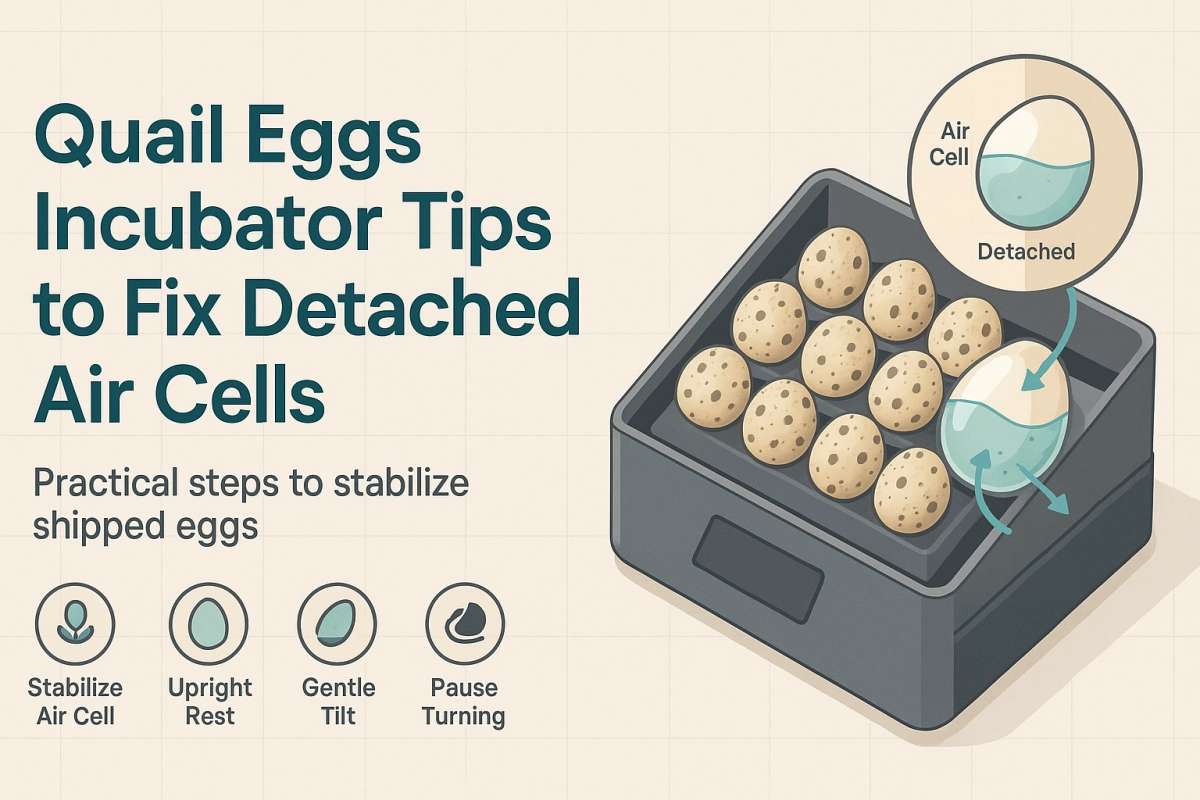
Many quail eggs that are shipped arrive with detached air cells due to vibration and rough handling. You will notice this when you candle the eggs. Allowing eggs to rest upright before setting lets the air cell reattach and improves outcomes. Gentle intake, short storage, and focused monitoring help your chicks develop well in a quail eggs incubator.
-
Shipped eggs often show detached, saddled, or wobbly (tremulous) air cells.
-
Resting eggs upright for 12–24 hours before incubation helps the air cell settle.
-
Early monitoring and a staged turning plan support hatch success.
These steps are doable at home, even if you are new to hatching.
Key Takeaways
-
Inspect and mark each quail egg for cracks and tracking; outline unusual air cells after candling. For a step-by-step, see egg candling day-by-day.
-
Rest shipped eggs pointed end down for 12–24 hours; extend to 48–72 hours if the air cell keeps drifting.
-
During the first 48 hours, prioritize stability: upright set, steady heat, and humidity tuned by air-cell growth and egg weight.
-
If the air cell is detached, avoid turning for 48 hours, then use gentle tilting before returning to normal turning. See turning quail eggs guide.
-
Keep concise logs of conditions and adjustments; patterns boost repeatable results. Reference the 17-day quail incubator checklist.
Intake Check
Marking and Identifying Eggs
On arrival, check each egg for cracks or leaks and discard any unsafe eggs. Use a light crayon or fine marker to add an ID and date. Keep marks small to avoid blocking pores. Flag odd shapes or thin shells for closer monitoring during incubation. Outlining the air cell after candling helps you track reattachment.
Tip: Mark one side with an X to simplify later turning, and lightly trace the air-cell rim if it looks saddled or mobile.
Inspecting Air Cells
Candle at the large end and watch how the air cell behaves as you gently tilt the egg. Classify what you see to guide handling:
| Visible Signs (Type) |
Recommendations |
|---|---|
| Detached: air cell shifts/floats |
Rest upright 24–48h; no turning; gentle tilting only after stabilization |
| Saddled: uneven rim on sides |
Upright set with slight blunt-end elevation; minimize handling; start with tilting |
| Tremulous: wobbly outline |
Extend rest; recheck at 24/48h; avoid full rolling turns until stable |
Documenting and Contacting Seller
Keep a simple log: ID, arrival condition, air-cell notes, ambient and box temperature. For severe displacement or damage, share photos and notes with the seller. Clean intake and records set you up for better results in a quail eggs incubator.
Resting Period
Pointed End Down
Place eggs in a clean carton with the pointed end down so the air cell can settle at the blunt end. If using a tilting tray, keep a slight blunt-end elevation. Upright, stable support protects fragile air cells.
Tip: Paper cartons improve airflow and grip compared to smooth plastic trays.
Rest Duration
Let eggs rest at room temperature for 12–24 hours before setting; extend up to 72 hours if the air cell remains mobile. While quail eggs tolerate up to a week of storage, longer holding increases variability. Re-candle at 24 hours to decide whether to extend rest.
-
Default to 24 hours of upright rest; extend if the air cell still drifts.
-
Some eggs still hatch with imperfect reattachment; set expectations accordingly.
-
Avoid extended storage beyond 7 days when possible.
Avoid Turning
Do not roll or turn during rest. For trays that can tilt, use gentle tilts every 2–4 hours rather than rolling. After rest, move to the incubator and follow the staged plan below.
Note: Minimizing motion now gives the air cell the best chance to reseat.
Quail Eggs Incubator Setup
Temperature and Humidity
Set a stable environment before adding eggs. Forced-air incubators should be 99.5°F; still-air ~101°F at egg top. For the first 24–48 hours, hold humidity around 45–50% to discourage fluid sloshing and support air-cell seating. Then maintain 45–55% for most of incubation, based on air-cell depth and weight loss. Place the unit away from drafts, and avoid large swings.
| Parameter |
Value |
|---|---|
| Temperature |
99.5°F / 37.5°C |
| Humidity |
45–50% RH (first 24–48h), then 45–55% RH |
Tip: Track air-cell depth and weight loss (target ~11–13% by lockdown) instead of chasing a fixed humidity number.
Sensor Placement
Place thermometers/hygrometers at egg-top height for representative readings. Use an empty shell filled with rice to seat sensors. Calibrate against a trusted device and use at least two sensors. Good data drives better adjustments.
-
Avoid blocking vents; do not reduce ventilation just to raise humidity—increase water surface area instead.
-
Dual sensors catch drift and failures early.
No Turning First 48–72 Hours
With detached or unstable air cells, keep the turner off for 48 hours after setting. Once reattachment is observed, begin gentle tilting before resuming full turns. This staged approach balances stability and embryo needs.
First 48 Hours
Monitoring Air Cells
Candle at 24 and 48 hours with the blunt end up. Look for a steady, settled air cell that no longer skates. If it stays in place through gentle tilts, reattachment is likely. Track sizes and weights: aim for roughly 11–13% total weight loss by lockdown. If the air cell lags (too small), lower humidity slightly; if too large, raise humidity.
Tip: Keep candling brief and consistent; log ID, air-cell notes, and weights.
| Condition |
Effect on Air Cell Growth |
|---|---|
| High Humidity |
Slows evaporation; air cell grows too slowly (small) |
| Low Humidity |
Speeds evaporation; air cell grows too fast (large) |
| Correct Weight Loss |
Supports normal hatch; target ~11–13% by lockdown |
-
Humidity is a tool, not a fixed number—let air-cell growth guide you.
-
Maintain roughly 45–50% RH at first and adjust based on trend.
-
Candle again on days 7, 10, 14, and 18 to track progress.
When to Resume Turning
Resume only when the air cell holds steady at the blunt end through gentle tilts. Start with tilting for a day, then shift to normal turning (4–6 times/day at ~45°), or an automatic schedule around 60–120 minutes/turn. If instability persists at 48 hours, continue upright with tilting and reassess at 72 hours; avoid delaying normal turning beyond day 7.
| Action |
Timing |
|---|---|
| No Turning |
First 48h (unstable air cells) |
| Gentle Tilting |
After stabilization; bridge to normal turns |
| Normal Turning |
4–6x/day or auto every 60–120 minutes |
Note: Stop turns three days before expected hatch (quail day 14). See lockdown basics.
Continue Tilting if Needed
If the air cell remains tremulous at 48 hours, extend upright set with tilting (two to four times/day) rather than full rolls. Return to normal turning after clear stabilization. Gentle staging protects fragile air cells while meeting embryo requirements.
-
Turning prevents adhesion and supports exchange; tilting is a safer bridge step.
-
Automatic turners offer consistency once stability returns.
-
Always verify stabilization before changing the schedule.
With careful staging and logs, your quail eggs incubator can produce strong chicks even after shipping.
Troubleshooting & Quick Reference
Common Failures
Typical issues with shipped eggs include:
-
Early embryo loss from rough transit, temperature swings, or humidity errors.
-
Non-pipping linked to excessive humidity or poor ventilation.
-
Shrink-wrapped chicks when humidity crashes or the lid is opened during lockdown.
-
Poor uniformity from insufficient or delayed turning.
-
Detached/saddled air cells that hinder proper positioning.
A 50% hatch rate can be reasonable with detached air cells; good handling and monitoring often improve this. For patterns and fixes, check quail incubation troubleshooting.
Solutions and Adjustments
Match issues to actions:
| Problem |
Solution |
|---|---|
| Early embryo death |
Verify sensors; stabilize temperature; track weight loss trend |
| Non-pipping |
Lower humidity, ensure airflow, check air-cell depth |
| Shrink-wrapped chicks |
Raise RH to ≥65% during lockdown; avoid opening |
| Poor chick uniformity |
Resume timely turning once stabilized |
| Detached air cells |
Upright rest 48h; tilting bridge; normalize after stability |
Always let air-cell growth and weight loss guide humidity. Target roughly 11–13% loss by lockdown, adjusting in small steps.
Tip: If the air cell sits on the side, set the egg at ~45° with the air cell uppermost; gravity assists reseating.
Quick Reference Card
Keep this near your incubator:
-
Temperature: 99.5°F (forced air), ~101°F (still air at egg top)
-
Humidity: Start 45–50% (first 24–48h), then 45–55% guided by air cell/weight
-
Turning: Wait 48h if detached; then tilt; normal 4–6x/day or auto every 60–120 min
-
Timeline: Quail ~17 days; stop turning on day 14
-
Monitor: Candle/log days 7, 10, 14, 18; aim ~11–13% weight loss by lockdown
You can lift quail hatch rates with a clear protocol: inspect and mark on arrival, rest pointed-down, stage turning from no turn → tilt → normal, and steer humidity by air-cell growth and weights. Keep concise logs and use the guides linked above for checkpoints.
Data authenticity note: temperatures, humidities, timelines, and handling thresholds here reflect common poultry-hatching practice, extension-style guidance, and experienced breeder records. For page cleanliness no external links are shown; detailed source descriptions are available on request.
FAQ
How do I know if my quail eggs have detached air cells?
Candle at the blunt end; if the air cell drifts, looks saddled, or wobbles when you tilt, treat it as unstable. Lightly outline the rim for tracking.
What is the best way to rest shipped quail eggs before incubation?
Place eggs pointed end down at room temperature for 12–24 hours; extend to 48–72 hours if needed. Do not roll or turn during this period.
When should I start turning my eggs in the incubator?
After 48 hours and only once the air cell stays seated during gentle tilts. Bridge with tilting for a day, then resume normal turning at ~45°.
How do I adjust humidity for the best hatch rate?
Watch air-cell depth and weigh eggs. If growth is slow, lower RH slightly; if fast, raise RH. Aim for roughly 11–13% total loss by lockdown.
What should I do if chicks do not hatch or seem weak?
Review temperature stability, ventilation, and your turning log. Keep lockdown humidity ≥65% and avoid opening. Use your records to refine next time.
0 Comments