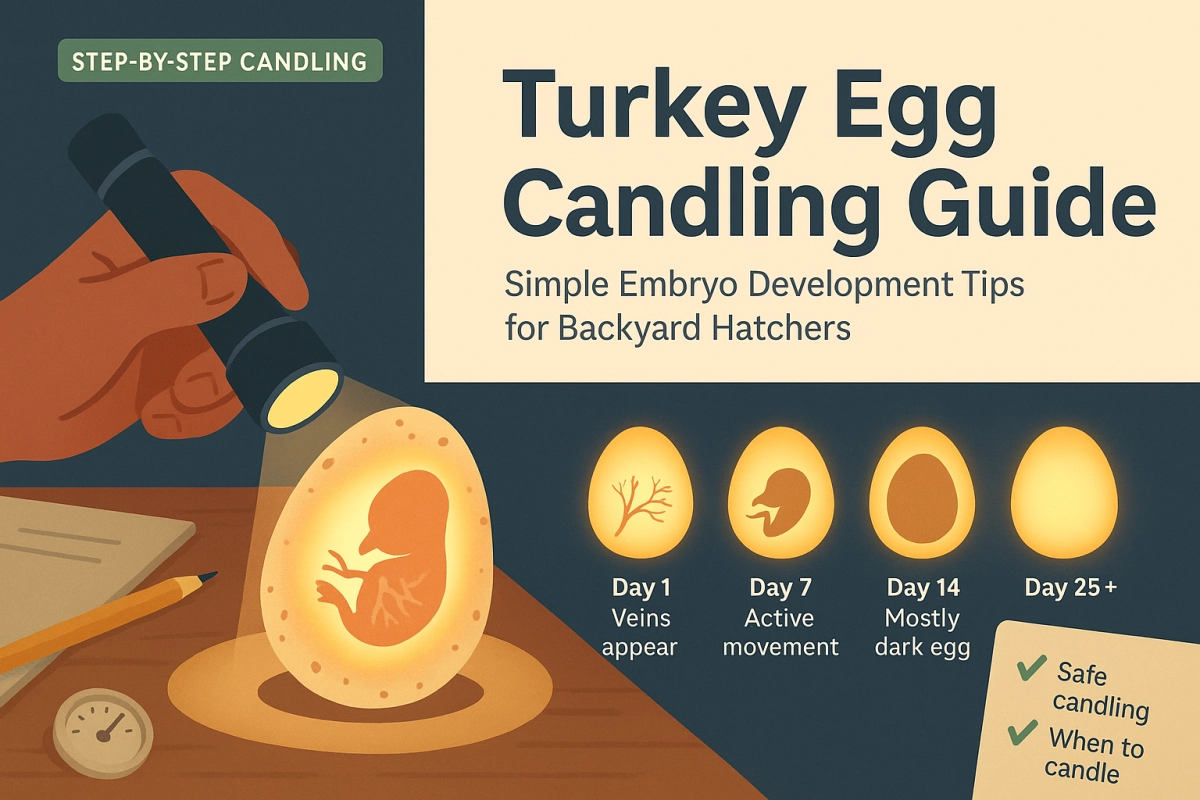
You can learn turkey egg candling step by step. When you know what to look for at each stage, you worry less and make better decisions for your flock. This guide walks you through the 28-day turkey egg incubation timeline, shows you what normal growth looks like, and explains which eggs you should remove to protect the rest.
Key Takeaways
-
Turkey eggs usually take about 28 days to hatch in an incubator. You can plan to candle mainly around day 7–10, day 14–18, and once near day 24–25 if needed, and then stop before hatch.
-
A healthy egg will show clear veins and a small dark spot at the first candling. Later the egg looks mostly dark inside, with a larger air cell at the big end and gentle movement.
-
Clear eggs with no veins by around day 10–14, strong blood rings, or eggs that never change between candling checks usually will not hatch and should be removed.
-
Quick, gentle candling in a dark room is safe. Keep each egg out of the incubator for less than a minute and avoid extra checks during the first three days and the last three days.
-
A stable, easy-to-view incubator makes candling much less stressful. Features like clear sides, steady temperature and humidity, and automatic turning help you focus on what you see inside the egg.
What Is Turkey Egg Candling and Why It Matters
Simple definition of turkey egg candling
Turkey egg candling means shining a bright light through the shell so you can see what is happening inside the egg. You usually do this in a dark room with a strong flashlight or a special egg candler. The light lets you see the air cell, the network of veins, and the growing embryo.
Candling gives you useful information without breaking the shell. You can check if an egg is fertile, see if the embryo is still alive, and follow how the air cell grows. This helps you remove eggs that are clearly not developing and keep the incubator cleaner and safer for the rest.
Why candling matters for hatch rates and safety
When you incubate turkey eggs, some eggs will always fail. This can happen even when you do everything right. Candling does not fix bad eggs, but it lets you catch problems earlier. When you remove eggs that never start growing or eggs that stop early, you lower the risk of rot, leaks, and even rare “exploding eggs” in the incubator.
Many poultry guides recommend candling a few times during incubation, not every day. This gives a good balance between information and safety. Even with careful candling and a good incubator, you should remember that no method can guarantee a 100% hatch rate. Your goal is to give each egg a fair chance and protect the overall batch.
Turkey Egg Incubation Basics and Candling Schedule
28-day turkey egg incubation in simple steps
Turkey eggs usually hatch in about 28 days when you use an incubator with stable temperature and humidity. Most home hatchers use a forced-air incubator set close to 99.5°F (37.5°C) and keep humidity around the mid-40s to low-50s percent for most of the incubation. In the final three days, they raise humidity into the mid-60s to low-70s percent and stop turning the eggs.
Early in incubation, the embryo is very small and fragile. During roughly the first week, your main job is to hold temperature and humidity steady, keep the incubator closed, and let the eggs settle into a normal pattern of development.
If you want a full breakdown of temperature, humidity, and turning targets for the whole 28 days, you can read our detailed guide on turkey egg incubation temperature and humidity settings . This candling article focuses on what you will see inside the egg rather than every number on your incubator display.
Recommended candling schedule for home and school projects
You do not need to candle turkey eggs every day. In fact, too many checks can do more harm than good because every extra lid opening lets heat and moisture escape. A simple, beginner-friendly schedule looks like this:
-
Days 0–6: Do not candle. Let the eggs warm up and the embryo begin to form. Focus on steady temperature and humidity.
-
Day 7–10: First real candling session. Check for veins and a small dark spot. Remove eggs that are clearly clear or badly damaged.
-
Day 14–18: Second main candling. Look for a larger dark area, an active embryo, and a bigger air cell. Remove eggs that still look empty or that show no sign of growth since the first check.
-
Day 24–25: Optional final check before lockdown finishes. Many hatchers only do this if they suspect a problem. You mainly confirm air cell size and basic position and then leave the incubator closed for hatch.
Try to avoid candling in the first three days and the last three days before hatch unless you have a strong reason. Early embryos are very delicate, and late embryos are getting into hatch position. For most backyard and classroom projects, two or three thoughtful candling sessions are enough.
If you want an incubator that holds stable conditions from day 1 to day 28 with less effort, you can look at a turkey egg incubator for home and small farms . A stable machine makes each candling session more meaningful because you are not constantly fighting big swings in temperature and humidity.
What Healthy Turkey Eggs Look Like at Each Candling Stage
Early candling (day 7–10): veins and a tiny embryo
The first time you candle turkey eggs, you will probably be around day 7–10. In a fertile, developing egg, you can usually see a small dark spot with fine veins that look like a spider web. The veins reach out from the embryo into the rest of the egg. The rest of the contents still look fairly light and clear.
In some eggs, especially if the shell is thick or has strong pigment, the view is not very sharp. You may only see the veins when you move the light around and give your eyes a moment to adjust. A little variation is normal as long as you see some kind of vein network and the contents are not completely clear.
At this stage, a completely clear egg with no veins is likely infertile or stopped very early. A strong, unbroken red ring circling the inside of the shell usually means early embryo death. These eggs almost never recover and are safer to remove.
Mid incubation (day 14–18): more darkness and a growing air cell
By the second candling around day 14–18, a healthy turkey embryo fills much more of the egg. You often see a large dark area with veins that are thicker than before. When you move the egg gently, you may see the dark mass shift or see small kicks near the edge of the shadow.
The air cell at the large end of the egg should be clearly visible and larger than it was at the first candling. As the chick grows and loses moisture, the air cell slowly expands. This is one of the easiest ways to judge whether your humidity is in a good range.
It is normal for some healthy eggs to look “too dark” to see every detail. As long as the air cell is present and the dark area looks solid rather than cloudy, many hatchers choose to keep these eggs and check progress again only if they have a reason to worry.
Late incubation (day 24–28): almost full egg and hatch prep signs
In the final few days, a normal turkey egg often looks nearly full of chick when you candle. Most of the shell will look dark, and the air cell will be quite large, often taking up about one third of the egg at the big end. You might see slight movement at the border between the air cell and the dark mass as the chick shifts.
As hatch time gets close, you may or may not see an internal pip. This is when the chick breaks through the membrane into the air cell and starts to breathe air for the first time. Many hatchers stop candling once lockdown begins and instead watch for external pips and hatching sounds from outside the incubator.
If you want to compare what you see with real photos of air cells and common problems, you can use our day-by-day egg candling photo guide . It focuses on air cell growth and red flags and works well alongside this turkey-specific overview.
Problem Signs When Candling Turkey Eggs (And What to Do)
Clear eggs, blood rings, and no-growth embryos
Some eggs will show clear warning signs when you candle them. The goal is to remove these eggs at the right time so they do not risk the rest of the clutch. Here are a few of the most important problem patterns:
-
Completely clear egg after day 10–14: This egg likely was never fertile or the embryo died very early. If you see no veins and no dark spot at the second candling, it is usually safe to remove the egg.
-
Strong blood ring: A bright red ring that circles the inside of the shell usually means the embryo started to grow and then died. These eggs will not hatch and can spoil if left inside the incubator.
-
No change between two candling checks: If an egg shows only a tiny dark spot and faint veins at both the first and second candling, with no sign of growth, the embryo has almost certainly stopped.
-
Cloudy or milky contents with no clear structure: This can mean the egg contents have broken down. The egg may smell bad or show wet spots on the shell. Remove it at once.
Simple decision table for common candling results
You can use this table as a quick guide when you look at each egg. It does not replace your judgment, but it helps you make calm, repeatable choices.
| What you see when candling | What it likely means | What you can do |
|---|---|---|
| Clear egg with no veins at day 10–14 | Infertile or very early embryo death | Remove the egg. Note it in your records and move on. |
| Strong red blood ring around inside of shell | Early embryo death | Remove the egg soon to avoid rot, leaks, or rare explosions. |
| Dark mass with clear air cell and some movement | Normal late development | Keep the egg. Stop candling near hatch and let the chick finish. |
| Cloudy contents, bad smell, or wet-looking shell | Egg has spoiled | Remove the egg at once and clean the incubator after the hatch. |
| Very dark egg with no movement seen, close to hatch | Could be alive or dead; hard to tell late | Leave in place unless you see clear signs of rot or severe smell. |
Try to base your decision on at least two candling sessions when possible, rather than one quick look. This helps you avoid throwing out a slow but healthy embryo. Always trust your nose and your eyes if an egg looks or smells unsafe.
How to Candle Turkey Eggs Safely at Home and in Classrooms
Step-by-step safe candling routine at home
At home, you can set up a simple and safe candling routine. The goal is to get a clear view of each egg in just a few seconds. Here is a straightforward process you can follow:
-
Choose a dark room or wait until evening so your candling light stands out.
-
Use a bright LED flashlight or a purpose-built egg candler with a tight beam.
-
Wash and dry your hands. Open the incubator only as far as you need to take one or two eggs at a time.
-
Hold the egg with the large end toward the light. Place the light right against the shell so very little light leaks out.
-
Turn the egg slowly and look for veins, dark areas, and the air cell. Keep each egg out for well under a minute whenever possible.
-
Put each egg back in the same position or mark the shell lightly with a pencil so you can track changes between sessions.
Many incubator manuals suggest planning your candling sessions in advance. Planned checks that are quick and calm are safer than opening the incubator randomly every day because you are curious.
Extra tips for classroom and kids’ turkey egg projects
When you candle eggs in a classroom, you have extra goals. You want to keep the eggs safe and also give students a clear and exciting view of life inside the shell. A few small changes to your routine can help:
-
Select one or two “demo eggs” with good development for each candling day. Keep the rest in the incubator to avoid long open times.
-
Set up the candling station a little away from the incubator so students do not bump into the machine while they watch.
-
Let students come up in small groups, and remind them not to shout, shake the table, or touch the egg unless you hand it to them.
-
Use a camera or phone to project the candling image on a screen if you can. This lets everyone see without handling the egg directly.
-
Limit classroom candling to two or three planned sessions, such as day 10, day 16, and day 24. Use photos and diagrams on other days to teach the rest of the story.
For classrooms and family projects, a small desktop incubator with a clear top and simple controls is often easier to manage than a large cabinet-style unit. It keeps the eggs visible while still protecting them from little hands.
How the Right Incubator Makes Turkey Egg Candling Easier
Incubator features that help with candling and monitoring
Some incubators make candling much easier than others. The basic job of any incubator is to hold steady temperature and humidity, but a few extra features can make a big difference when you want to watch turkey egg development:
-
Clear 360° view or large window: You can often see movement and internal shadows without opening the lid as often.
-
Automatic turning: The machine turns eggs on a set schedule so you do not need to handle them many times each day.
-
Stable temperature and humidity control: A reliable thermostat and easy-to-fill water channels help keep readings close to target.
-
Built-in light or candling tool: Some units include a built-in light that you can use to check eggs quickly, which cuts down the time each egg spends out of the warmed air.
An automatic egg incubator with a clear 360° view is a good example of a design that helps with candling as well as daily care. The wide viewing area and automatic turning let you keep a close eye on your eggs without constant handling.
When to consider upgrading your turkey egg incubator
You may not need a new incubator right away. Many people hatch their first few batches in a very simple machine. But it can make sense to upgrade when you notice patterns like these:
-
You see big swings in temperature and humidity even when the room is stable.
-
You find it hard to candle quickly because you must remove many parts or fight condensation on tiny windows.
-
You lose many eggs late in incubation even though your candling results looked good early on.
A better incubator cannot fix poor eggs or very rough handling, but it can remove many avoidable problems. Upgrading is often cheaper in the long run than losing batch after batch of poults. Still, no incubator can promise perfection, so keep your expectations realistic and use candling as one tool among many.
Quick FAQ: Common Turkey Egg Candling Questions
When is it too late to candle turkey eggs?
For most home and classroom setups, it is best to stop candling once lockdown begins. This is usually around day 25 for turkey eggs. After that point, chicks are getting into hatch position, and every extra lid opening lets out warm, moist air that they need. If you suspect a serious problem like a rotten egg, use your nose and sight and act carefully, but avoid casual checks late in the process.
Can I candle turkey eggs every day?
You can, but you should not. Daily candling adds extra stress and extra chances for mistakes. A few planned sessions at key days are enough for most people. Aim for around day 7–10 and day 14–18, with one late check only if you truly need it. Keep each session short and focused, and spend the rest of your time keeping the incubator steady.
Why can’t I see veins in my turkey eggs yet?
There are a few common reasons you may not see veins. The egg may still be very early in development, the shell may be thick or dark, your light may not be strong enough, or the embryo may have stopped. If you are earlier than day 7, it may simply be too soon. If you are past day 10 and still see a clear egg with no veins, it is likely not developing. In that case, wait for the second planned candling to confirm before you remove the egg.
Sometimes, candling will leave you unsure about one or two eggs. When that happens, mark those shells with a pencil and keep them in the incubator until the next check. With practice, you will grow more confident in reading what the light shows you and in knowing when to let an egg go.
If you ever reach hatch day and see a chick that seems close but cannot finish on its own, do not rush to open the shell. Instead, follow a careful turkey assisted hatching guide so you do not cause bleeding or harm by helping too early or too fast.
0 Comments