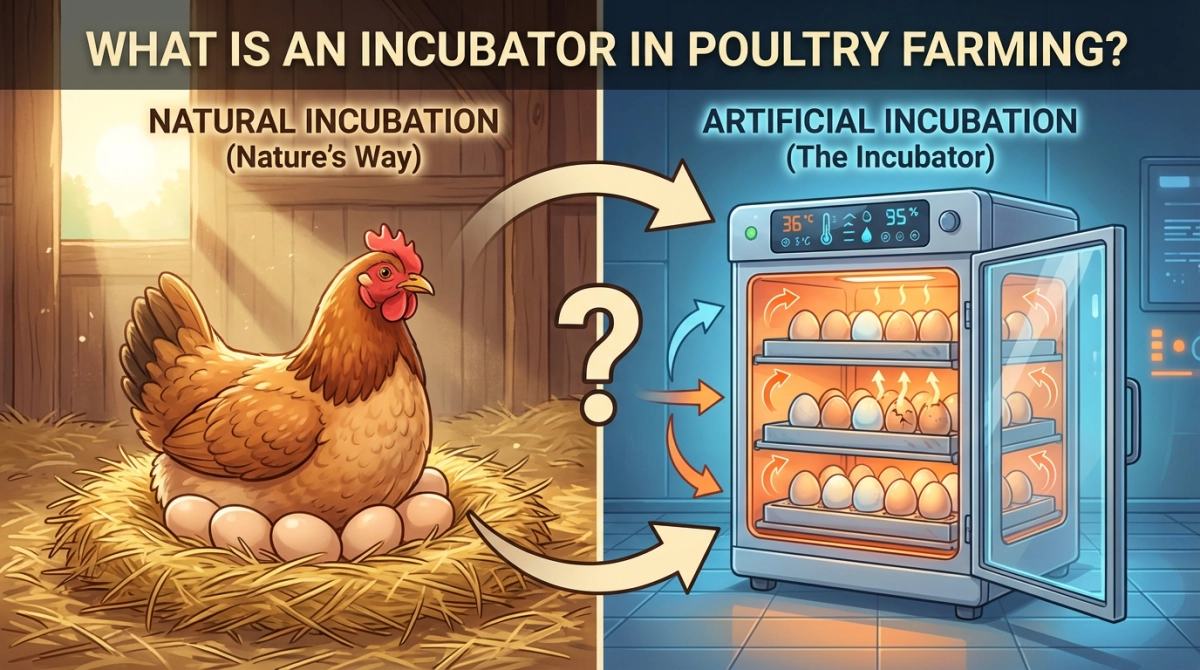
An incubator in poultry farming gives eggs a safe, warm place to hatch when you cannot rely on a broody hen. It holds the temperature and humidity steady, day and night, so the tiny embryo inside the egg can grow in peace. For small farms and backyard flocks, it turns hatching from “hope and guesswork” into a planned part of your year.
You can think of a good incubator as an “artificial hen” that does not get tired, leave the nest, or stop laying forever just because it wants to sit on eggs.
If you are not sure you need an incubator, it helps to look at your goals. Maybe you only want a few extra chicks now and then. Maybe you want steady batches of birds for eggs, meat, or a classroom project. If you are closer to the second picture, an incubator can be one of the most useful tools on your place. When you reach that point and want to see what the machines look like, you can browse our egg incubator collection and see beginner-friendly models that fit small flocks.
Key Takeaways
- An incubator in poultry farming keeps eggs at a steady temperature and humidity so the embryo can grow and hatch on time.
- Most small forced-air incubators aim for about 99.5°F (37.5°C) and keep chicken eggs there for 21 days.
- For chicken eggs, many poultry guides suggest holding humidity around 45–55% for the first 18 days, then 65–70% during the last three days of hatch.
- An incubator lets you plan when to hatch, how many chicks to expect, and which hens and roosters you want to keep in your breeding group.
- You do not always need an incubator, but it becomes very helpful when broody hens are rare, your climate is harsh, or you want steady batches of chicks each year.
Who Needs an Incubator in Poultry Farming
Deciding If You Need One
You might wonder if you really need an incubator in poultry farming. Many of us started with a few hens in the yard and just hoped one hen would decide to sit on eggs. That can work for a while, but it is not very steady.
If your goal is to add a handful of chicks once in a while, a good broody hen may be enough. You can let that hen do the work and enjoy the sight of her taking care of her own brood. In that case, an incubator is nice to have, but not urgent.
If you want more control, an incubator can help. You can choose the week to start, count the days to hatch, and set up your brooder and feed ahead of time. You do not have to wait for a hen to “feel like it.” You should consider an incubator when you want steady temperature and humidity and you want hatching to follow your plan, not the hens’ moods.
Common Use Cases
Here are some of the most common ways small farmers and backyard keepers use incubators:
- Hatch chicks from your best hens and roosters so you can keep strong lines in your flock.
- Raise extra birds for meat or egg sales at a farmers market or in your neighborhood.
- Hatch at a time that fits school breaks or farm tours so students or visitors can see chicks pip and hatch.
- Replace older hens in an orderly way instead of buying started pullets every year.
- Work around harsh weather when it is too cold, too hot, or too wet for natural nests to stay safe.
You do not need a big commercial farm to use an incubator. A small machine can already give a family flock or teaching program plenty of chicks each year.
What an Incubator in Poultry Farming Does
The Artificial Hen Role
A broody hen does four main jobs when she sits on eggs. She keeps them warm, she keeps them slightly moist, she turns them, and she lets fresh air move through the nest. An incubator tries to copy all of these jobs inside a small box.
In a forced-air incubator, a fan moves the warm air around the eggs. The heater holds the air at about 99.5°F (37.5°C), which most extension guides list as a good target for chicken eggs in a modern tabletop incubator. In a still-air incubator, there is no fan, so the warm air rises. In that case, the top of the eggs must read about 101–102°F to keep the embryo in the right range.
The incubator also holds some water in channels or trays to control humidity. The extra moisture slows the loss of water from the egg. If humidity is too low for many days, the egg loses too much water and the chick can end up crowded in a dry shell with a tight inner membrane. If humidity is too high, the chick may not lose enough water and can drown in extra fluid near hatch.
Many modern incubators also handle turning for you. They tilt or roll the eggs several times a day during the first 18 days for chicken eggs. This helps keep the embryo from sticking to the shell and lets the growing blood vessels spread around the yolk.
Where It Fits on Your Farm
For a big commercial hatchery, an incubator is a large machine that holds thousands of eggs and runs like a piece of factory equipment. For a backyard keeper, the picture is different. Your incubator might sit on a shelf in your house or in a quiet room in the barn, and it might hold 12 to 60 eggs at a time.
On a small farm, the incubator sits between your breeding pens and your brooder. You collect eggs from the hens and roosters you like best, set them in the incubator, and then move the hatched chicks to a warm brooder box. The incubator gives you a predictable “pipeline” of chicks without tying up your hens for weeks at a time.
In a school or youth program, the incubator becomes a teaching tool. It lets students candle eggs, listen for peeping, and watch chicks pip and zip around day 21. You can schedule the start date so hatch day lands when the class is present.
Natural vs Artificial Incubation
Pros and Cons for Small Flocks
Natural incubation with a broody hen is simple. The hen does the work, keeps the eggs warm, and teaches the chicks how to scratch and drink. It feels very natural and does not cost anything up front.
But broody hens also bring limits. Not every breed has strong broody instincts. Some hens start strong and then abandon the nest halfway through. While a hen is broody, she often stops laying and may lose weight.
Artificial incubation with a machine costs money and needs a little learning time. You must plug it in, monitor the readings, and keep records. In return, you get more control over timing and batch size, even if no hen feels like sitting. For many small flocks, a well-run incubator can give hatch rates that match or beat most hens.
Success Rates and When to Switch
In real life, good hatch rates cover a range, not one exact number. Many flock keepers see natural hatch rates around 70–85% with a reliable broody hen. With a well-managed incubator, it is common to see 85–95% hatch on fertile eggs once you dial in your settings and habits.
You might think about switching to an incubator, or at least adding one, when:
- You have few or no broody hens in your flock.
- You want to hatch more chicks than one hen can cover at once.
- You need to plan hatches around work, school, or farm events.
- You want to keep better records on which hens and roosters give the strongest chicks.
Using an incubator does not mean you must give up broody hens. Many small farms use both. The incubator covers the planned batches, and a favorite hen can still raise a clutch now and then when she decides to sit.
Setting Up an Incubator for Poultry Eggs
Temperature and Humidity Basics
Temperature is the most important setting in your incubator. For most small forced-air incubators and chicken eggs, the target is about 99.5°F (37.5°C). Still-air incubators need about 101–102°F at the top of the eggs to keep the embryo in the right range.
Small changes for a short time are normal and usually do not ruin a hatch. Big swings, or staying too hot or too cold for many hours, can harm the chicks. Too hot and they may hatch early, weak, or with deformities. Too cold and they may hatch late or not at all.
Humidity controls how much water the egg loses over the 21-day cycle. Many poultry guides suggest keeping chicken eggs around 45–55% relative humidity for the first 18 days. During the last three days, often called “lockdown,” you raise humidity to about 65–70% to keep the inner membranes soft while the chick pips and zips.
Your local climate matters. In a very dry area, you may need more water surface in the incubator to reach those numbers. In a very damp area, you may need fewer water channels open. A small separate thermometer and hygrometer inside the incubator can help you check if the built-in readings are accurate.
If you enjoy the science behind these numbers and want to see more detail on how heat and moisture move inside the shell, you can read our guide on how an incubator works and the science behind successful hatching .
Turning, Ventilation, and Monitoring
Turning keeps the yolk and embryo from sticking to the shell. For chicken eggs, you usually turn from day 1 through day 18. Many keepers turn at least three times a day by hand if there is no automatic turner. Then they stop turning for the last three days so the chick can settle into hatching position.
Ventilation lets fresh air move through the incubator. The growing chick uses more oxygen as it gets bigger. Most small incubators have small vents you keep partly open. You should keep the vents clear and not block them with towels or plastic.
You do not have to stare at the incubator all day. A quick check in the morning and evening is enough for most people. Look at the temperature and humidity, listen for odd noises, and make sure the water channels have not dried out.
Species Comparison Table
You can use one incubator for different poultry species, but you should hatch one species at a time until you gain more practice. Different birds need different days in the incubator and slightly different humidity. The table below shows common targets for a small forced-air incubator:
| Poultry species | Typical days to hatch | Target temperature (forced-air) | Humidity days 1–18 | Humidity last 3 days | Day to stop turning |
|---|---|---|---|---|---|
| Chicken | 21 | 99.5°F (37.5°C) | About 45–55% | About 65–70% | Day 18 |
| Coturnix quail | 17–18 | 99.5°F (37.5°C) | About 45–55% | About 65–70% | Day 14–15 |
| Mallard-type duck | 28 | 99.5°F (37.5°C) | About 45–55% | About 65–75% | Day 25 |
| Muscovy duck | 35–37 | 99.5°F (37.5°C) | About 45–55% | About 65–75% | Day 31–32 |
These numbers are a good starting point based on common poultry guides. Each incubator model and each farm may need small tweaks, but if you stay close to this range you will already be in a safe zone.
Matching Incubator Size to Your Flock
How Many Eggs to Hatch
Before you buy an incubator, it helps to look at your whole plan. Ask yourself how many chicks you want to hatch in a year, not just in one batch. Also think about how many adult birds you can house and feed once those chicks grow up.
For a family flock, many people only need 10–30 new chicks a year to keep egg production steady. For a small farm that sells eggs or meat, the number might be higher. An incubator that holds 12–24 eggs per batch can already serve many backyard keepers well.
Bigger machines are not always better. A large cabinet incubator is great for hundreds of eggs but can feel like too much to manage if you are just starting. It is often wiser to learn on a smaller machine, then move up only if you find you truly need more chicks on a regular schedule.
Choosing Capacity and Features
When you look at incubators, focus on a few simple features first. A clear lid or window helps you see eggs without opening the machine. A gentle, reliable automatic turner saves you time and cuts down on mistakes. A clear digital display for temperature and humidity is easier for new hatchers than tiny dials with no numbers.
Many backyard keepers are happy with a compact incubator that holds a few dozen eggs and comes with automatic turning. For example, a three-tray automatic egg incubator for birds and quail is already enough for most small flocks and classroom projects. You can look at a model like our three-tray incubator for birds and quail if you want a concrete picture of this size and style.
Start with the size that fits your current flock and your current housing. It is easier to fill a small incubator with good eggs than to fill a giant one just because the space is there.
Troubleshooting and Common Concerns
What If Something Goes Wrong?
No matter how careful you are, something will go wrong at some point. Power may go out during a storm. A water tray may run dry. A setting may get bumped. That does not mean the hatch is lost.
If the power drops for a short time, keep the lid closed. The warm air and the eggs themselves hold heat for a while, much like a closed oven. You can cover the incubator with a dry towel or blanket to slow heat loss, but make sure you do not block the air vents completely.
When the power comes back, let the temperature climb slowly back to normal. Do not crank the heat high to “make up” for lost time. A slow return to 99.5°F is kinder to the chicks than a big spike.
If you find that temperatures have run hot or cold for many hours, make a note in your records. Later, when you candle or open unhatched eggs, you can compare what you see with your notes. This is how many of us learned what our own incubators like to do.
New Hatcher Worries
New hatchers often worry most about day 21. The calendar says it is hatch day, but the eggs sit there like nothing is happening. It is easy to panic at that point.
A normal hatch does not always start right at the same hour. If your temperature has been steady, it is common for the first pips to show late on day 20, sometime on day 21, or even on day 22. Listen for little peeps and tapping sounds. Look for tiny star-shaped cracks.
Try not to open the lid every few minutes. Each time you open it, warm and moist air escapes and the membrane around the chick can dry out. Give the chicks time to work. It can take many hours from the first pip to the time the chick is fully out of the shell.
If this hatch does not go the way you hoped, you are not alone. Every experienced hatcher has lost eggs and made mistakes. The important thing is to learn one or two clear lessons from each batch so the next one goes better.
Getting Ready for Your First Hatch
Pre-Hatch Checklist
Before you set your first eggs, it helps to walk through a simple checklist. This keeps you from scrambling on day 18 when the chicks are almost ready.
- Run the incubator empty for at least 24 hours and check that temperature and humidity stay close to your targets.
- Place a separate thermometer and hygrometer inside to see if the built-in display is accurate.
- Choose clean, normal-shaped eggs from healthy hens. Avoid cracked, dirty, huge, or tiny eggs.
- Mark each egg with the set date and a simple mark like “X” and “O” on opposite sides if you plan to hand turn.
- Prepare your brooder area with a safe heat source, bedding, feeder, waterer, and chick starter feed.
If you feel ready to go deeper into setup and want a step-by-step walk-through, you can follow our beginner egg incubator guide. It walks you through the process one easy step at a time.
First-Time Tips
Keep your first hatch simple. Start with one species, such as chickens, and one batch. Avoid mixing different kinds of eggs in the same hatch until you are confident with the basics.
Write down your settings and what you see. Note the average room temperature, any power cuts, and how many eggs developed and hatched. These notes will become one of your best tools over time.
Remember that a good incubator helps a lot, but it cannot fix poor parent stock, bad storage, or very rough handling of eggs. Good chicks start with healthy hens and roosters, clean nests, and careful collection.
When your first chick hatches, give yourself a moment to enjoy it. You and that little machine just did the work that a broody hen normally does, and that is something to feel proud of.
FAQ
Is an incubator necessary?
You do not always need an incubator. If you have reliable broody hens and only want a few chicks now and then, natural incubation can work well. An incubator becomes more useful when you want steady batches, rare breeds, or you live where hens do not go broody often.
Can I use one incubator for different poultry species?
You can use one incubator for chickens, ducks, or quail, but it is best to hatch one species at a time while you learn. Each bird has its own number of days and small differences in humidity. Once you feel confident, you can explore more advanced mixed hatches if your incubator design supports it.
How many eggs do I need to make it worth it?
For a small family flock, hatching 10–30 chicks a year often justifies a small incubator, especially if you would otherwise buy started pullets. For a small farm that sells birds or eggs, the number can be higher. The key is to match incubator size to how many birds you can house, feed, and sell comfortably.
What problems does an incubator solve?
An incubator gives you steady temperature and humidity and does the turning on a fixed schedule. It removes the guesswork of waiting on a hen to sit and stay. It also lets you hatch when the weather and your own schedule make sense, not just when a hen feels like going broody.
Who benefits most from using an incubator?
Backyard keepers, small farmers, and teachers often benefit the most from using an incubator. You get more control, more learning moments, and more chances to keep the lines you love. If that sounds like you, an incubator can be a very steady partner in your poultry plans for many years.
0 Comments