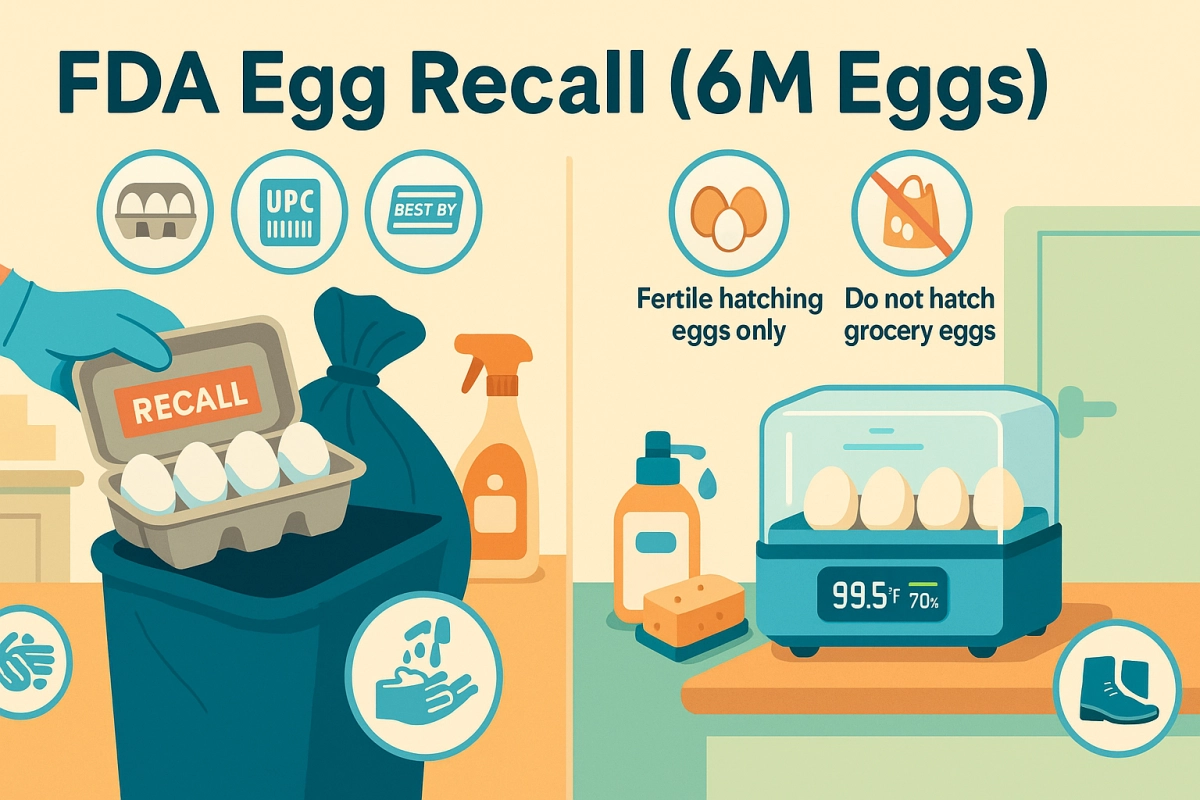
FDA Egg Recall (6M Eggs): Safe Handling — And Why You Should Never Hatch Grocery Store Eggs
The FDA advised consumers not to eat, sell, or serve certain Black Sheep Egg Company cartons after multiple environmental samples tested positive for Salmonella. This post explains (1) how to check your cartons and clean up safely, and (2) the correct, incubation-ready workflow: choosing proper fertile hatching eggs, sanitizing gear, and locking in temperature & humidity for a healthy hatch — including why you should never try to hatch grocery store eggs.
Recall quick facts (what to check now)
- Brand: Black Sheep Egg Company
- Products: 12- and 18-count Free Range Large Grade A Brown Eggs
- Best-By: 08/22/2025 – 10/31/2025 (on carton side)
- UPCs:
860010568507,860010568538 - Distribution: AR, MO, MS, TX, CA, IN (some lots repackaged by other firms)
- FDA classification: Class I (highest risk level)
If your carton matches: do not eat. Discard or return it, then wash hands and clean any shelf, tray, or utensil the eggs touched. See official guidance linked in Sources.
Don’t hatch grocery store (or recalled) eggs — here’s why
Grocery eggs are packaged and handled for safe eating, not for incubation: most are not fertile, and food-safety washing/refrigeration lowers or eliminates viability. If a carton is under recall, attempting to incubate it also carries unnecessary hygiene and biosecurity risks.
For a real hatch, start with fertile hatching eggs from reputable hatcheries/breeders. New to incubation? Keep this primer handy: What is an Egg Incubator? Simple Guide + 21-Day Timeline.
Pre-incubation: choosing proper hatching eggs
- Source: buy fertile hatching eggs from reputable sellers; avoid table eggs.
- Storage before setting: hold eggs large end up around 60–69 °F; set within ~3–10 days of lay.
- Shell hygiene: pick clean, intact shells; skip heavily soiled eggs (don’t “scrub to perfection”).
First time buying/handling hatching eggs? Bookmark our step-by-step: Beginner’s Egg Incubation Guide and the full Day 0–21 walkthrough.
Sanitation & disinfection: your incubator SOP
- Power off & cool the unit. Remove liners, trays, turner parts. Wash with warm water + mild detergent.
- Disinfect using an incubator-safe solution (follow label). Rinse if required and let parts air-dry completely.
- Biosecurity habits: dedicated tools/shoes for the hatching area, hand-wash in/out, keep wildlife out.
Need pictures for each step? See: Incubator Instructions (Complete Step-By-Step).
Temperature & humidity: lock it in before Day 18–21
- Pre-stabilize: run the incubator for hours before setting eggs; avoid chasing every micro-swing.
- Forced-air baseline: ~99.5 °F (37.5 °C). Still-air: measure at egg-top, ~102 °F.
- Humidity: mid-50% RH early; raise to ~65–70% RH at lockdown (Day 18–21).
- Weight-loss check: expect ~12–14% total loss by hatch; adjust humidity to track the curve.
Deep-dive on numbers and troubleshooting: Chicken Egg Incubator Temperature Guide and Manage Incubator Temperature & Humidity.
One-page pre-incubation checklist (print-friendly)
- ✅ Use fertile hatching eggs; never hatch grocery/recall eggs.
- ✅ Store large-end-up at cool room temps; set within ~3–10 days.
- ✅ Clean → Disinfect → Dry incubator & tools before every batch.
- ✅ Pre-stabilize temp/RH; forced-air ~99.5 °F, still-air ~102 °F (egg-top).
- ✅ Raise humidity to ~65–70% at lockdown; keep opening the lid to a minimum.
• Shop Chicken Egg Incubators • Explore All Egg Incubators • Universal Egg Incubator (multi-species)
Sources (official & coverage)
- FDA Advisory — Recalled Black Sheep Egg Company Eggs
- Media roundups — Health.com, Yahoo / Allrecipes, Real Simple, Southern Living
- EggBloom learning hub — Beginner Guide, Incubator Instructions, Temperature Guide, Day 0–21 Guide
FAQ
Can I hatch grocery store eggs?
No. Most are not fertile and are handled/refrigerated for eating, not incubation. Start with fertile hatching eggs from hatcheries or breeders.
What should I do if I bought recalled eggs?
Don’t eat them. Discard or return them. Then wash hands and clean any shelves/containers and utensils the eggs touched (hot, soapy water).
What’s a safe baseline for incubator temperature & humidity?
Forced-air: ~99.5 °F; Still-air: ~102 °F measured at egg-top. Aim for ~55% RH early and ~65–70% RH at lockdown; confirm progress with ~12–14% total egg weight-loss by hatch.
0 Comments